How to Price AI-Assisted Freelance Work: The Honest Numbers Behind Value-Based Pricing
A freelance copywriter used to charge $50 an hour and bill eight hours for a landing page — $400 total. With Claude or ChatGPT handling first drafts, the same page now takes three hours. If that copywriter still bills hourly, they just made $150 for identical output. This is the math most freelancers using AI have not run yet, and it explains why two people offering functionally the same AI-assisted service can end up in completely different income brackets — not because one is more skilled, but because one is still selling time and the other figured out they should be selling the outcome.
If you're short on time, here's the key takeaway: Hourly billing actively penalizes AI-assisted freelancers, because becoming faster and better at your job reduces your income under that model. The shift that captures AI's efficiency gain as profit rather than giving it away as a discount is moving to value-based or project-based pricing — quoting the deliverable and the outcome, not the clock time. Typical 2026 rates run from $50/hour at the commodity marketplace floor to $300-$500+/hour for specialized senior consultants, but the real leverage is escaping the hourly model entirely, not climbing within it.
Why Hourly Billing Is Structurally Broken for AI-Assisted Work
The mechanics are straightforward once you see them clearly. AI does not replace a freelancer's judgment, editing skill, or client communication — it eliminates the blank-page problem and compresses every phase of production that used to take real hours. Under hourly billing, that compression is a direct pay cut. You have turned your growing expertise into a liability: the better you get at using AI to work faster, the less you earn for the same client outcome.
This is not a hypothetical concern for the future. Freelancers who stay on hourly billing in AI-assisted fields are already facing a structural race to the bottom, as clients increasingly benchmark freelancer rates against what AI tools can produce directly, and push for lower per-hour pricing accordingly. The median freelance AI engineer on a major marketplace charges around $50 an hour — and if you compete on hourly rate in an AI-saturated category, that marketplace floor becomes your gravity, with AI continuously pulling it lower as the tools make everyone faster. The whole point of repricing is climbing away from that floor entirely, not negotiating a slightly better hourly number within it.
What Value-Based Pricing Actually Means in Practice
Value-based pricing means quoting the deliverable and the outcome rather than the hours behind it. "Landing page copy: $500" instead of "copywriting: $75/hour." This single change lets you keep the efficiency gain AI provides as profit margin, rather than passing that gain back to the client automatically in the form of a shorter, cheaper invoice.
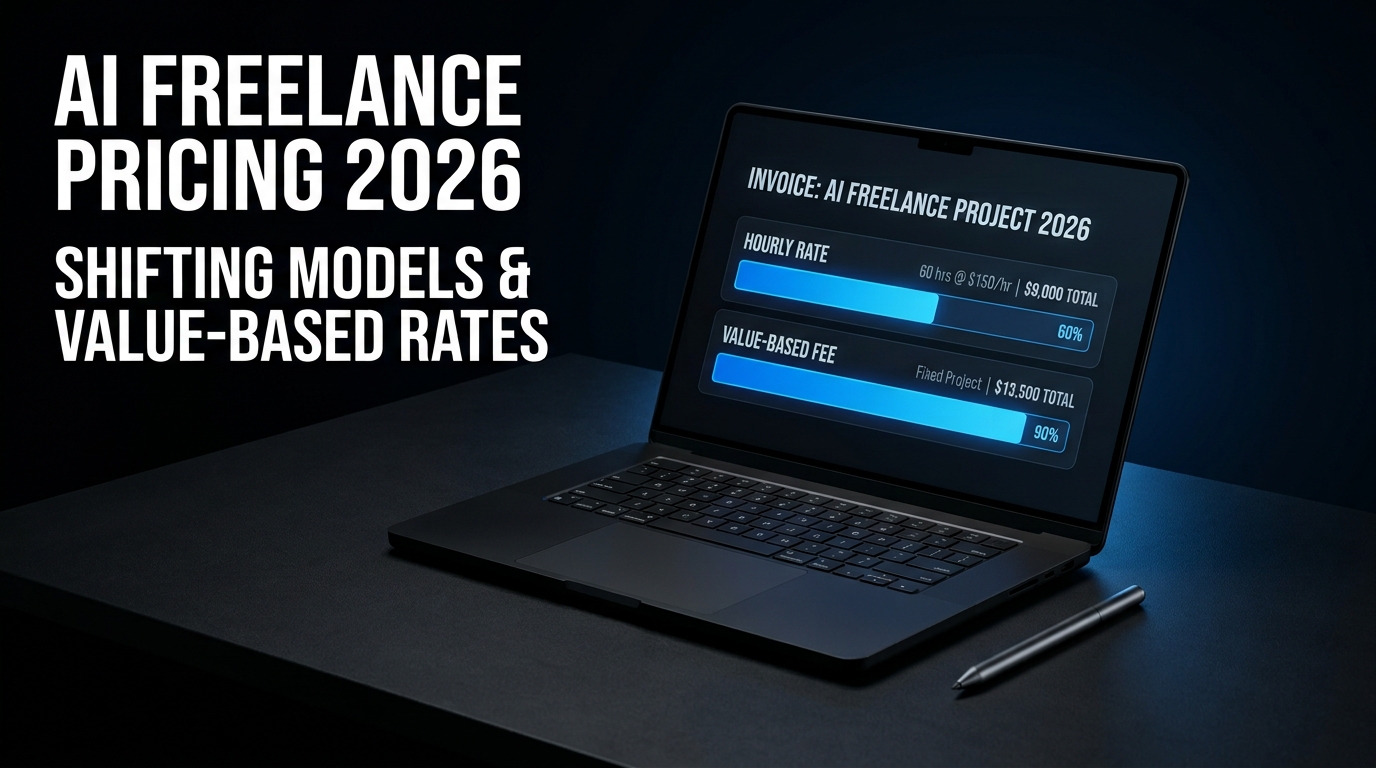
The math is not subtle. A 30-hour project priced at $85/hour totals $2,550. The identical project priced as a fixed deliverable at $5,000 produces an effective rate of $167/hour — more than double, for the exact same output. The client is not actually paying for your time in either case. They are paying for the outcome. AI lets you reach that outcome faster, which should increase your effective rate, not decrease it — but only if your pricing model is structured to capture that gain rather than automatically discount it away.
Alan Weiss, whose work essentially defined modern value-based consulting pricing, has one rule worth internalising directly: never quote a fee before you have established the value the work creates for the client. Pricing the deliverable requires understanding what that deliverable is actually worth to the person buying it — a landing page that converts an extra 2% of traffic is worth vastly different amounts to a business doing $10,000 a month in revenue versus one doing $500,000, even though the freelancer's time investment might be identical.
Building Your Price Floor (Even Though It Shouldn't Set Your Price)
Before you can price toward value, you need an honest floor — the minimum you can charge without losing money, even as a solo operator working alone. Calculate delivery cost as your realistic hours multiplied by a loaded rate that includes your own time, even if no one else is on the invoice. Add any direct AI tooling cost — subscription or API spend genuinely attributable to the project. Add a buffer for infrastructure, revision cycles, and the inevitable scope creep that shows up on almost every real engagement.
This floor exists as a safety check, not as your actual pricing strategy. If a client's budget cannot clear your floor, walk away — competing below it is how freelancers stay busy while quietly losing money on every project. But the floor should almost never be what determines your final price. The ceiling — set by the value you create for that specific client, in that specific situation — is where the real pricing decision happens, and it is frequently several multiples higher than the floor calculation alone would suggest.
What the Actual Market Rates Look Like in 2026
Rates vary enormously by specialization and positioning, and the spread itself is informative. AI consulting rates in 2026 span roughly $100-$150/hour for junior consultants up to $300-$500+/hour for senior, specialized experts — with generative AI specialization commanding a 20-30% premium over general AI consulting work. A "custom AI agent" build, similarly, ranges anywhere from $10,000 to well over $100,000 depending entirely on how the work is positioned — the same underlying build can be a $10K commodity or a $100K business outcome depending on framing, not on hours worked.
That spread is the actual lesson here more than any specific number. Treat published rate ranges as a rough map, not a target to hit — anchor your own pricing on the specific value you create for a specific client's specific problem, not on matching a table that describes a market average you may have no interest in competing inside. This connects directly to the broader positioning work covered in AI skills worth selling in 2026 — the tier you operate in determines which pricing conversation is even available to you.
How to Actually Make the Transition From Hourly
Shifting an existing client relationship from hourly to value-based pricing is the part most freelancers avoid, because it requires an uncomfortable conversation about how you have historically billed. The practical path: use hourly rates only for genuinely uncertain exploration phases, where scope has not yet been defined clearly enough to price a fixed deliverable responsibly. Once scope is clear, price everything else as a defined outcome.
For new clients, this is significantly easier — you set the pricing model from the first quote, with no prior hourly relationship to unwind. For existing clients accustomed to hourly invoices, introduce value-based pricing on the next new project or deliverable rather than attempting to convert an ongoing hourly retainer mid-stream. If a client pushes back and insists on hourly billing, that is a legitimate signal worth listening to — but it is also worth directly educating them that they are paying for the outcome and the expertise behind it, not for clock time, and that AI-assisted efficiency should benefit the relationship's value, not just compress your invoice.
What I Like / What I Don't Like
What I like: The math behind value-based pricing is genuinely compelling and easy to verify for yourself — running your own recent projects through both models (actual hours billed versus what a value-based quote would have produced) makes the case concretely rather than abstractly. The shift rewards exactly the behaviour that makes AI worth adopting in the first place: getting faster and better at delivering outcomes, rather than punishing that improvement. The framing also protects against the race-to-the-bottom dynamic that is genuinely reshaping the lower tiers of freelance marketplaces as AI compresses commodity work.
What I don't like: Value-based pricing requires genuinely understanding a client's business well enough to estimate the value of an outcome, which is a real skill gap for freelancers used to simply quoting hours — the transition is not just a pricing mechanics change, it requires developing a different kind of client conversation. The published rate ranges circulating online are self-reported by agencies and consultants with every incentive to inflate them, and treating them as gospel rather than a rough map risks either underpricing yourself out of insecurity or overpricing based on numbers that do not reflect your actual market position. And clients accustomed to hourly billing sometimes genuinely prefer the predictability and transparency of that model, which means the transition is not universally smooth even when the math clearly favours the freelancer.
Bottom Line
Hourly billing and AI-assisted freelance work are structurally at odds — the better and faster you become, the less hourly billing pays you for it. Value-based and project-based pricing is the fix, and it is not a marginal optimisation; the same project can produce double or more the effective rate depending entirely on which model you price it under. The transition requires a genuine floor calculation as a safety check, a real understanding of client-specific value as the actual pricing driver, and a willingness to have a different, more uncomfortable conversation with clients than "here's my hourly rate."
Who should make this shift now: any freelancer or consultant who has noticed AI compressing their delivery time without a corresponding increase in what they invoice. Who can wait: freelancers still in genuinely uncertain-scope exploration work, where hourly billing remains the honest and appropriate model until a deliverable is clear enough to price as an outcome.
Join the newsletter for more practical AI workflows and freelance systems.