Outsourcing vs AI Automation: When to Hire a Human and When to Build a Workflow
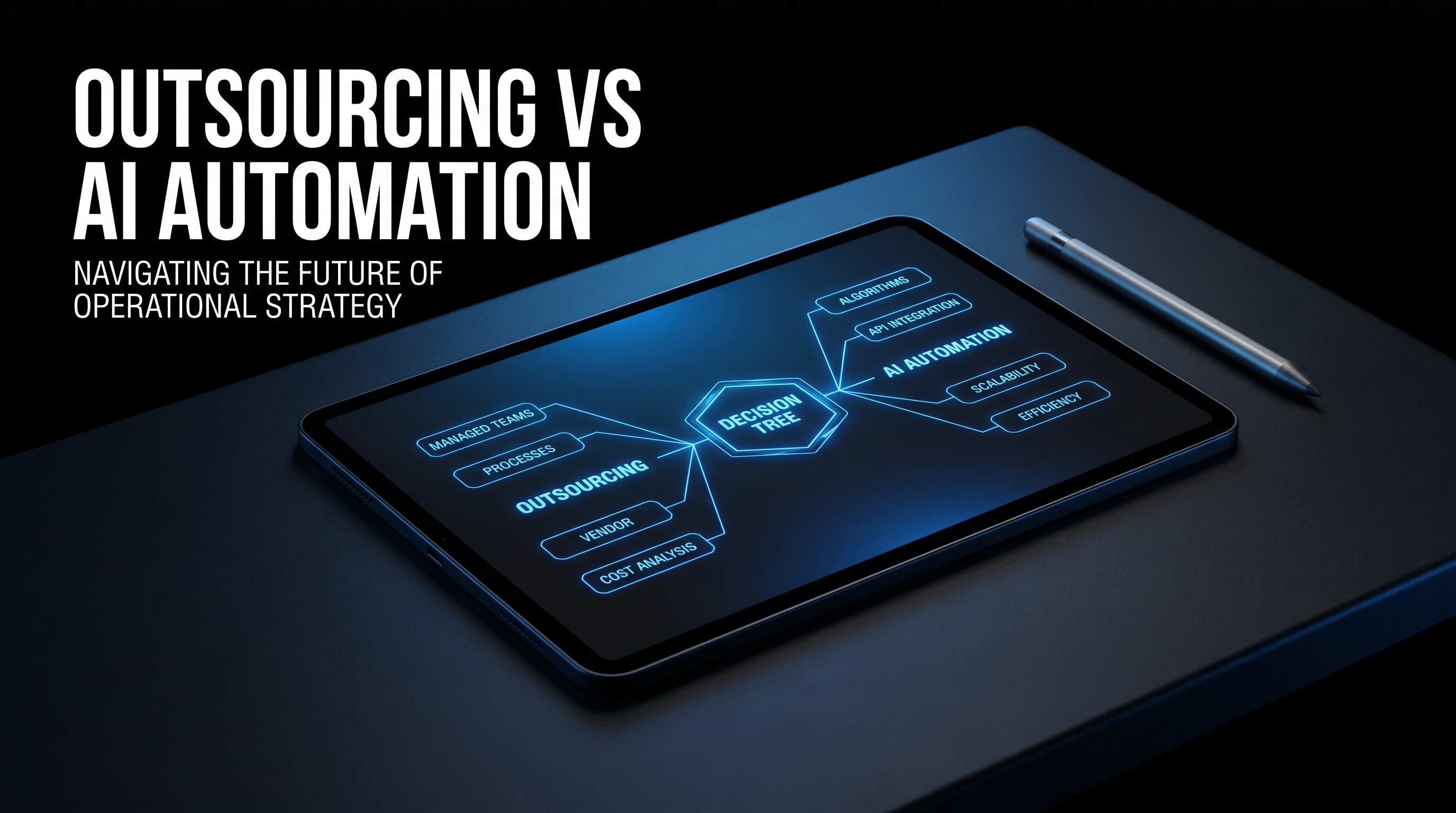
Most solopreneurs get this decision backwards at least once, and it's usually expensive. They automate a task that genuinely needed human judgment — a client-facing email, a sensitive negotiation, a piece of content that required real taste — and the output reads exactly like what it is: unsupervised AI making decisions it was never equipped to make. Or they hire a virtual assistant to do something that should have been a two-hour n8n workflow, and six months later they are still paying someone $600 a month to manually copy data between two apps that could talk to each other directly.
If you're short on time, here's the key takeaway: The decision between outsourcing and AI automation comes down to one question — is the task repetitive and rule-based, or does it require judgment, creativity, or relationship? Automate the first category. Outsource the second. Most solopreneurs need both working together, not one replacing the other entirely. The businesses scaling well in 2026 default to automation first, and reach for a human only when the task genuinely cannot be reduced to rules — not the other way around.
Why This Decision Actually Matters
Every hire increases fixed costs — salary, payroll overhead, onboarding time, management attention, tools, and real ramp-up risk before that person becomes genuinely productive. Automation has real setup effort too, but once deployed, the marginal cost of handling one more instance of the task is usually close to zero. That asymmetry is the entire economic case for defaulting to automation wherever it genuinely fits — not because outsourcing is bad, but because the cost structure of the two options is fundamentally different, and getting the choice wrong compounds every month you keep paying for the wrong solution.
The businesses actually scaling as one-person operations in 2026 are not doing everything themselves, and they are not defaulting to hiring either. When something genuinely needs a human, they hire contractors for specific, defined tasks — an editor, a virtual assistant, an occasional specialist — rather than adding payroll by default. Headcount becomes the last resort, not the reflexive response to feeling overwhelmed. This connects directly to the broader systems framework in business systems automation with AI — this decision is one specific application of that larger sequencing discipline.
The Rule That Actually Decides This
The clearest version of the decision rule: if it's repetitive and rule-based, automate it. If it needs creativity, judgment, or relationship, outsource it to a human. This single sentence resolves the majority of ambiguous cases faster than any elaborate decision matrix, because it forces you to name what the task actually requires rather than defaulting to whichever option feels more familiar or comfortable.
Repetitive, rule-based tasks share a specific signature: the same input reliably produces the same correct output, the steps can be written down as an explicit sequence, and the task does not require reading a room, exercising taste, or making a judgment call that depends on context a machine cannot see. Data entry, scheduling, invoice reminders, routine social posting, and moving information between two systems all fit this pattern cleanly. Judgment-based tasks share the opposite signature: the right answer depends on nuance, relationship history, tone-matching, or a decision that genuinely benefits from a human perspective — writing a compelling email that authentically matches your voice, negotiating a client contract, or designing something that does not look like it was assembled from a template.
The Cost Comparison Most Solopreneurs Never Actually Run
A typical AI-augmented solo operator stack — a language model plus an automation platform plus a couple of specialized tools — runs $80 to $200 per month per function automated. Compare that to a quality offshore contractor at $1,200 to $3,000 per month for the equivalent function, and the gap looks decisive in automation's favor. But this comparison only holds when the task is genuinely automatable in the first place — the mistake most people make is seeing that AI costs $25 a month and assuming it must be cheaper than a $1,200 offshore hire, then automating a task that actually required human judgment, and absorbing the cost of cascading failures downstream instead.
The honest framing: before comparing costs at all, first confirm the task belongs in the automation category. A cheap tool automating the wrong kind of task is not a bargain — it is a slower, harder-to-diagnose failure than simply hiring the human the task actually required from the start. Once a task is confirmed as genuinely rule-based, the cost math consistently favors automation, and the gap widens as volume increases, because your marginal cost per additional instance barely moves while an equivalent human hire adds real capacity constraints past a certain volume.
Why Undocumented Processes Should Never Be Automated First
One of the most common and costly sequencing mistakes: automating a process before it has ever been done consistently by a human. If you cannot clearly explain your own workflow to another person, you genuinely cannot train an AI system to execute it reliably — the ambiguity in your own head becomes ambiguity baked into the automation, except now it fails silently instead of asking you a clarifying question.
The correct sequence when a process is still fuzzy: do it manually or with a human contractor first, document exactly how it actually works — not the idealized version, the real one including the exceptions — and only then automate it once the steps are genuinely clear and repeatable. This matters more than it might initially seem, because automating chaos does not produce order. It produces chaos that now runs unsupervised and faster, which is a meaningfully worse failure mode than a manual process that at least surfaces its own inconsistency to a human who can catch it.
The Hybrid Model That Actually Works in Practice
The strongest operating model for most solo businesses in 2026 is not automation instead of outsourcing — it is a deliberate hybrid where each handles what it is genuinely suited for. AI handles the repetitive requests, the first response, the routing, the summaries, and the routine updates. Humans handle the complex decisions, the relationship conversations, the genuine exceptions, and anything touching growth strategy or judgment calls that carry real consequences if they go wrong.
A concrete example of this pattern working well: an AI system scans incoming documents and highlights the sections that likely matter, but a human reviews those highlights and makes the actual final call — the AI does the volume work, the human does the judgment work, and neither is asked to do the job the other is better suited for. This is not a compromise between two competing approaches. It is the two approaches doing what each is genuinely good at, deployed together rather than in competition.
How to Actually Apply This to Your Business
List your ten most time-consuming recurring tasks honestly, without editorializing about which ones you'd prefer to delegate. Mark each one as either repetitive and rule-based, or judgment-based and relationship-dependent — most tasks sort cleanly once you ask this specific question rather than a vaguer "should I delegate this" framing. Estimate the monthly hours and the real cost of each task in its current state, whether that cost is your own time valued honestly or an existing contractor expense.
For anything landing clearly in the rule-based category, model what automating it would actually require — the setup time, the tool cost, and a realistic payback window. For anything landing clearly in the judgment category, evaluate outsourcing to a contractor rather than attempting to force an AI workaround that will underperform a human on exactly the dimension that made the task judgment-based in the first place. Choose one task with a genuinely measurable outcome — hours saved, tasks completed, response time reduced — and implement whichever solution actually fits before moving to the next item on the list. Sequencing one change at a time, with a real before-and-after measurement, is what separates a solopreneur who is systematically improving their operation from one who is randomly trying tools and hoping something sticks.
What I Like / What I Don't Like
What I like: The rule-based versus judgment-based framing genuinely resolves most ambiguous cases faster than any more elaborate decision framework — it forces a specific, answerable question instead of a vague feeling about what "should" be automated. The cost asymmetry between automation's near-zero marginal cost and a human hire's real fixed costs is a genuine structural advantage, not marketing spin, once you have correctly identified that a task actually belongs in the automatable category. The hybrid model reflects how the strongest solo operators are actually running their businesses in 2026, not an idealized compromise nobody actually implements.
What I don't like: The framework makes the decision sound cleaner than many real tasks actually are — plenty of work sits genuinely in a gray zone between rule-based and judgment-based, and forcing a premature binary choice on those tasks can produce a worse outcome than acknowledging the ambiguity and starting with a human until the pattern becomes clearer. The temptation to automate before documenting is real and easy to fall into precisely because automation feels like progress while documentation feels like administrative overhead — and that impulse is exactly what produces automated chaos instead of automated efficiency. And the cost comparison, while directionally accurate, depends heavily on correctly diagnosing which category a task belongs to in the first place — the framework only pays off if that initial diagnosis is honest rather than optimistic.
Bottom Line
The decision between outsourcing and AI automation is not a competition between two approaches — it is a sorting problem, and the sort itself is straightforward once you ask the right question. Repetitive and rule-based: automate it, and let the near-zero marginal cost compound in your favor as volume grows. Judgment-based, creative, or relationship-dependent: outsource it to a human, because that is genuinely what the task requires, regardless of how much cheaper the automated alternative appears on a monthly subscription line.
Who should run this audit now: any solopreneur who has never explicitly sorted their recurring tasks into these two categories and is defaulting to whichever solution feels more familiar rather than what the specific task actually requires. Who should hold off on automating anything new: anyone whose core processes are still undocumented or inconsistent — get a human doing the task reliably and documented first, then automate what has become genuinely clear.
Join the newsletter for more practical AI workflows and business systems.