The 5-Email Welcome Sequence That Converts Cold Subscribers Into Buyers
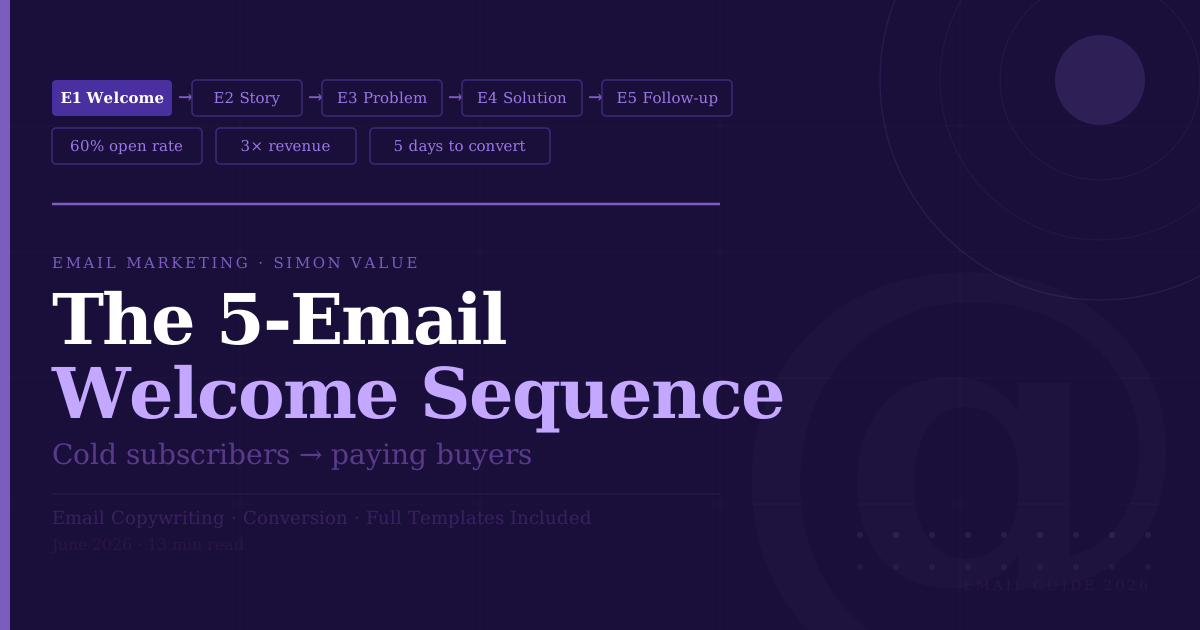
Most welcome sequences waste the highest-attention moment in the entire subscriber relationship. Here's the exact 5-email framework that turns a free lead into a paying customer — before they forget who you are.
"The moment someone joins your list is the most valuable moment you will ever have with them. Most creators squander it with a 'thanks for subscribing' email and silence."
Here's a number that should change how you think about email: the average open rate for a welcome email is 50–60%. The average open rate for a regular newsletter is 20–25%. That means your new subscriber is two to three times more likely to open your first email than any email you send them later. The welcome sequence is not just a courtesy — it is your highest-leverage sales window.
The problem is that most creators treat the welcome sequence as administrative: confirm the signup, deliver the lead magnet, remind them the newsletter is coming. This wastes the attention spike. By email 3, open rates have dropped. By email 5, the subscriber has already mentally categorized you as "another newsletter."
The Simon Value welcome sequence is built on a different premise: a new subscriber is not a cold lead — they are a warm prospect who just raised their hand. The sequence converts curiosity into trust, trust into desire, and desire into a first purchase. In five emails. Over five days.
Why five emails? One email doesn't build trust. Two feel like a transaction. Five give you enough space to: deliver value, establish your worldview, surface a problem, offer the solution, and follow up once. That's the full arc of a sales conversation — compressed into a week.
Each email has a single job. If you try to combine jobs — deliver value AND pitch in the same email — the email will do neither well. One email, one purpose, one call to action. That constraint is what makes it convert.
| Primary goal | CTA type | Revenue impact | |
|---|---|---|---|
| E1 — Welcome | Deliver lead magnet · Build goodwill | Micro-commitment (reply) | Indirect |
| E2 — Story | Establish trust · Make them feel understood | Soft question (no buy CTA) | Indirect |
| E3 — Problem | Agitate pain · Create desire for solution | Reply invitation (no buy CTA) | Setup |
| E4 — Solution | Present the offer · Drive first purchase | Direct buy link × 2 | 50–70% of sales |
| E5 — Follow-Up | Handle objections · Close fence-sitters | Soft re-offer + reply | 30–50% of sales |
The Welcome Email
The welcome email has one job: honor the promise you made when they subscribed. Deliver the lead magnet. Tell them exactly what to expect. Do not add a lengthy backstory, three CTAs, or social media links. The subscriber's attention is high right now — one confusing email at this stage can undo the entire relationship before it begins.
The only secondary goal of Email 1 is a micro-commitment: ask the subscriber to do one small thing. Reply to a question. Click a link. This trains their inbox to flag you as important — and tells your email platform this is an engaged subscriber, protecting your deliverability.
Hey [First Name],
Here's your [LEAD MAGNET NAME]: [LINK]
I put this together because [one sentence on why this resource matters to them specifically]. Most people in [their situation] struggle with [the core problem] — this is the shortcut I wish I'd had.
While you're reading it, I have a quick question:
Just hit reply and tell me. I read every response.
Talk soon,
Simon
What makes this email work
One clear link to the lead magnet
One question that invites a reply
P.S. that previews Email 2
Under 200 words total
Three CTAs to different pages
A 400-word backstory about yourself
Social media follow buttons
A survey with 8 questions
Your Story
The story that converts is not the story of how successful you are. It's the story of the moment before you figured it out. The confusion, the false starts, the expensive mistakes. The breakthrough that changed everything. The reason you decided to help others avoid the path you had to take.
This email builds trust because it signals: you understand me because you've been where I am. When a subscriber feels understood, they stop treating your emails as content and start treating them as conversation.
Story email structure — 4 paragraphs
The Problem Email
Email 3 is where you demonstrate that you understand your subscriber's world better than they can articulate it themselves. This is the email that creates the "how did you know?" moment.
Identify the specific, named problem — not the surface problem ("I need more clients") but the underlying one ("I'm great at the work but terrible at selling myself, and it makes me feel like a fraud every time I try"). Describe that problem in language so precise that reading it feels like being understood for the first time.
Do not offer a solution in this email. The entire job of Email 3 is to make the subscriber feel seen. The solution comes tomorrow — and it will land harder because of the setup you've created here.
Hey [First Name],
I want to talk about something most people in [NICHE] don't say out loud.
It's not [surface problem]. Everyone talks about that. The real issue is [deeper, specific problem] — and it shows up as [specific, tangible symptom they recognize].
If you've ever [specific relatable scenario], you know exactly what I mean. It's the moment when [describe the internal experience — the frustration, the specific doubt].
Tomorrow I'm going to show you exactly what that solution looks like.
Talk soon,
Simon
Where to find the right language for this email
The Solution Email
Email 4 is the first place in the sequence where you ask for money. Done correctly, it doesn't feel like a sales pitch — it feels like the natural continuation of the conversation you've been building for three days. The subscriber has been delivered value, introduced to your story, and shown you understand their problem deeply. Now you're offering the fastest path to the solution.
Lead with transformation, not features. Your subscriber doesn't buy a "47-page PDF" — they buy the outcome that 47 pages delivers. State the price directly. Hesitation around pricing signals uncertainty about value — if you've done the validation work, own the number confidently.
Solution email structure — 5 parts
| Urgency type | Example | Credibility |
|---|---|---|
| Launch price | "$27 until Friday, then it goes to $47" | High |
| Expiring bonus | "Free 1:1 audit for the first 10 buyers" | High |
| Limited quantity | "Only 50 copies at this price" (if true) | High |
| Fake countdown timer | "Offer expires in 23:59:59" (resets on refresh) | Destroys trust |
| Vague urgency | "Act now before it's too late" | Ignored |
The Follow-Up Email
Between 30–50% of purchases from a welcome sequence come from the follow-up, not the initial offer email. This is the highest-ROI email in the entire sequence — and the one most creators skip because they're uncomfortable "pestering" people.
Email 4 reached subscribers at one moment in time. Some were busy. Some were interested but hesitant. Some had an unresolved objection they couldn't articulate. The follow-up catches all of them — and it does it without pressure, because pressure at this stage destroys the relationship you've spent four emails building.
Hey [First Name],
A couple of days ago I shared [PRODUCT NAME] with you. If you've already grabbed it — thank you. I'd love to hear how it's going.
If you're still on the fence, I want to address the three things that usually give people pause:
"I'm not sure it will work for my situation."
[One sentence with a concrete example or guarantee that addresses this directly.]
"I don't have time to use it right now."
[One sentence reframing the time investment: "The whole thing takes about 90 minutes."]
"Is it really worth $[X]?"
[One sentence on ROI: "One reader told me they made back the price in the first week."]
If none of those are your hesitation, just hit reply and tell me what is. I'll answer honestly.
Either way — [PRODUCT LINK] is still open if you decide it's right for you.
Talk soon,
Simon
How to find your real objections (before you write this email)
- All 5 emails written, proofread, and loaded into your email platform (ConvertKit, ActiveCampaign, MailerLite, etc.)
- Automation trigger set: sequence starts immediately on opt-in confirmation
- Delays set correctly: E1 instant, E2 +24h, E3 +48h, E4 +72h, E5 +120h (Day 5)
- Lead magnet link tested — downloads correctly on desktop and mobile
- Product link in E4 and E5 tested — goes to correct payment page
- Reply-to address is your real inbox — not a no-reply address
- All emails sent from plain text (no designed templates) for E2–E5
- Sequence tagged in your platform so buyers are automatically removed from the offer emails after purchase
| Metric | Minimum | Good | Excellent | What to do if below minimum |
|---|---|---|---|---|
| E1 open rate | 40% | 50–60% | 65%+ | Check your subject line — it should reference the lead magnet by name, not be generic. |
| E1 reply rate | 3% | 5–8% | 10%+ | Make the question more specific. "What are you struggling with?" gets fewer replies than "What's your biggest frustration with [X] right now?" |
| E4 click-through rate | 3% | 5–8% | 10%+ | Rewrite the outcome bullets — too many features, not enough transformation. Or the problem setup in E3 wasn't specific enough. |
| Sequence conversion rate | 1% | 2–4% | 5%+ | Total purchases ÷ total subscribers who entered the sequence. If below 1%, the problem is usually E3 (not enough pain) or E4 (offer/price mismatch). |
| E5 additional sales % | 20% | 30–40% | 50%+ | Percentage of sequence sales that came from E5 vs E4. If below 20%, E5 isn't addressing the real objections — gather data from replies and rewrite. |
After Email 5, the welcome sequence is complete — but the relationship isn't. The subscriber who didn't buy is not lost. They've read five emails and have a baseline understanding of who you are and what you offer. They are warmer than 99% of cold traffic you'll ever attract.
Move non-buyers into your regular broadcast schedule. Continue delivering value. Every product you launch, every piece of content you share, every email you send is another opportunity for that subscriber to become a buyer — when the timing is right for them. The sequence plants the seed. The ongoing relationship grows it.
The Simon Value email rules
Set It Up Once. Earn From It Forever.
This sequence runs automatically from the moment someone subscribes. You write it once, connect it to your email platform, and it works while you sleep, while you're creating your next product, while you're on holiday. It is the closest thing to passive income that actually exists in digital marketing.
The previous article in the Simon Value series covers exactly how to build the digital product you offer in Email 4 — from idea to launch in 24 hours. The sequence is only as strong as the product it sells. Make both exceptional.