The AI-Assisted Digital Product Launch Checklist: What Most Solopreneurs Skip (And Pay for Later)
Most digital product launches don't fail because the product is bad. They fail because a specific handful of unglamorous steps got skipped in the rush to hit "publish." Solopreneurs spend weeks perfecting the product itself — the copy, the design, the content — and then treat the launch as an afterthought: post a link, send one email, hope. The product might be genuinely good. The launch process around it is what determines whether anyone finds out.
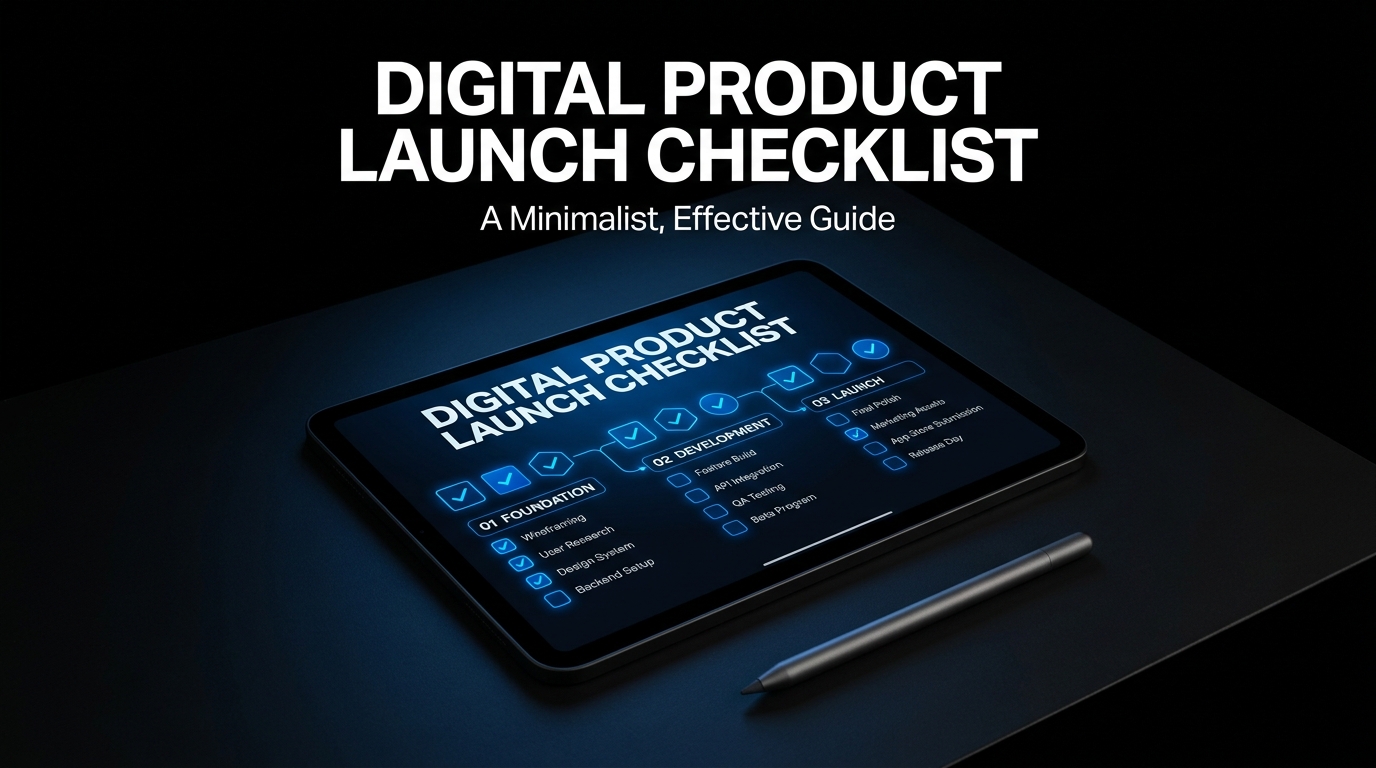
If you're short on time, here's the key takeaway: A digital product launch has three phases — pre-launch validation and setup, the launch sequence itself, and post-launch follow-through — and most solopreneurs execute the middle phase reasonably well while skipping most of the first and nearly all of the third. AI compresses the production work inside each phase significantly, but it does not replace the sequence. The checklist below covers what actually needs to happen at each stage, and flags the specific steps that get skipped most often.
Why the Skipped Steps Are the Ones That Matter Most
The steps that get skipped are rarely the visible ones. Nobody forgets to write the sales page. What gets skipped is validating the price before launch day, setting up the post-purchase email sequence before the first sale comes in, and following up with buyers after the initial 48-hour spike. These are unglamorous, low-visibility tasks — and they are disproportionately responsible for the difference between a launch that produces one spike of sales and one that keeps generating revenue for months.
The data on why this matters is not abstract. Course completion rates sit around three to six percent industry-wide, and refund requests on higher-priced digital products have risen as buyers increasingly expect AI to get them eighty percent of the way to a solution for free. That backdrop makes the pre-launch and post-launch phases more important than they were two years ago, not less — a launch with weak setup and no follow-through is competing in a market where buyers are more skeptical and more likely to ask for their money back. If you are building toward this, the broader digital products with AI framework covers the strategic layer this checklist executes against.
Phase One: Pre-Launch (The Phase Everyone Rushes)
Validate the price before you build the final version. Do not set a price based on what feels right in isolation. Look at five comparable products in your specific niche and price relative to that comp set, then test the price with a small pre-sale or a poll to your existing network before committing to it publicly. AI can help you research comparable pricing quickly, but the validation step itself requires a real signal from real potential buyers.
Build the sales page around a single, specific promise. Use AI to draft the page structure and copy variations quickly, but the core promise — the specific transformation a buyer gets — needs to come from your own understanding of the problem, not a generic AI-generated value proposition. A sales page drafted end-to-end by AI with no specific insight reads exactly like every other AI-generated sales page, and buyers in 2026 recognise that pattern instantly.
Set up the delivery mechanism before launch day, not during it. Confirm the checkout flow works end-to-end — as a test purchase, not a visual check — before you send a single promotional message. A broken checkout discovered after your first buyer complains is the fastest way to lose the momentum a launch depends on.
Write the post-purchase sequence before the first sale, not after. This is the step skipped most often, because it produces no visible progress before launch and feels like it can wait. It cannot. The first 24 hours after a purchase is when a buyer's excitement is highest and their likelihood of actually using what they bought is greatest — a delayed or generic delivery email quietly starts the countdown toward a refund request.
Phase Two: Launch (The Phase Everyone Gets Mostly Right)
Announce to your warmest audience first, not your broadest one. Your email list, if you have one, converts at a meaningfully higher rate than cold social traffic. Launch to the people who already trust you before broadening to colder channels — this sequencing also gives you real buyer feedback while there is still time to fix an obvious problem before wider exposure.
Use AI to draft launch content across formats, not to replace your voice in the highest-stakes messages. AI genuinely accelerates producing the launch email sequence, the social posts, and the follow-up reminders — drafting five pieces of launch content that used to take an afternoon can now take thirty minutes. The specific launch-day announcement, the one message most likely to convert your warmest relationships, is worth writing yourself or editing heavily, because it is the one place where genuine voice matters most.
Create urgency that is real, not manufactured. A founding-cohort price that increases after a specific date, a limited number of spots for a cohort-based product, or a bonus that expires at a real deadline all create legitimate urgency. Fake countdown timers that reset on refresh are increasingly recognised by buyers and actively erode trust rather than building it.
Track what is actually converting, not just what is generating traffic. Traffic without conversion data tells you nothing actionable. Know which specific channel — email, a specific social post, a specific community — is producing buyers, not just clicks, so you can double down during the launch window itself rather than analysing it afterward when the momentum has passed.
Phase Three: Post-Launch (The Phase Almost Everyone Skips)
Follow up with buyers after the initial spike, not just at delivery. A check-in message three to five days after purchase — asking how it's going, whether they are stuck anywhere — does two things simultaneously: it reduces refund requests by catching confusion early, and it surfaces the specific language and objections that improve your next launch's sales page.
Follow up separately with people who did not buy. Not everyone who saw the launch and did not purchase was uninterested — many were not ready yet, had a specific unaddressed objection, or simply missed the window. A single follow-up sequence addressing common objections, sent to people who engaged but did not convert, recovers sales that a one-shot launch leaves on the table entirely.
Turn buyer questions into the next version of the product. The specific confusion points that come up repeatedly during delivery are the clearest signal available for what to fix before the next cohort or the next launch. Treating your first buyers as co-creators — actively incorporating their feedback rather than just supporting them — produces a meaningfully better second launch than starting from scratch each time.
Set the next launch date before you lose momentum. A digital product that launches once and then sits dormant leaves most of its revenue potential unrealised. Whether the mechanism is a recurring cohort, an evergreen funnel, or a periodic re-launch to new audience segments, decide the next distribution moment while the current launch's lessons are still fresh, not months later when you have to relearn what worked.
Where AI Actually Saves the Most Time in This Sequence
The time savings from AI in a product launch are concentrated in specific, repeatable tasks rather than spread evenly across the whole process. Drafting multiple variations of launch copy, generating a first-pass email sequence structure, researching comparable pricing across a niche, and producing promotional graphics and social assets are all tasks where AI assistance turns hours of work into a focused half-day session.
What AI does not meaningfully compress is the judgment calls — the specific promise on the sales page, which objections matter most to your specific audience, and the tone of the one launch-day message that goes to your warmest relationships. Treating the checklist as a sequence where AI drafts and you decide, rather than a sequence AI can execute unsupervised, is what separates a launch that converts from one that reads like every other AI-assisted launch buyers have started to recognise.
What I Like / What I Don't Like
What I like: The three-phase structure makes it immediately obvious which part of the process is being neglected — most solopreneurs can identify their weak phase in under a minute of honest self-assessment. AI's time savings on the repeatable production tasks are real and substantial, turning what used to be days of copywriting and asset creation into a single focused session. The post-launch follow-through steps, once built into the checklist as non-negotiable rather than optional, meaningfully reduce refund rates and improve the economics of every subsequent launch.
What I don't like: A checklist this thorough can become its own form of procrastination — treating every item as equally mandatory for a first, small launch adds unnecessary friction to getting something in front of real buyers. The urgency and follow-up mechanics, done well, require genuine ongoing attention during the launch window, which is a real cost for a solo operator without any conversation-holding across three additional channels. And AI-drafted launch copy that has not been meaningfully edited for specific voice is increasingly detectable to buyers, which means the time savings promised by AI tools in this category are smaller than the marketing suggests once quality control is applied honestly.
Bottom Line
A digital product launch checklist is only useful if it corrects for the specific steps solopreneurs actually skip, not the ones that already get done reflexively. Pre-launch validation and post-purchase sequencing get skipped because they produce no visible progress before launch day. Post-launch follow-through gets skipped because the momentum has moved on to the next idea. AI meaningfully speeds up the production work inside each phase — but the sequence itself, and the judgment calls embedded in it, remain the solo creator's job.
Who should use this checklist as written: anyone launching their first or second digital product who has never systematically tracked which phase of the process they consistently neglect. Who can simplify it: solo creators running a fifth or sixth launch who already have a working post-purchase sequence and follow-up cadence in place — repeat what already works, and focus the checklist discipline on whatever changed since the last launch.
Join the newsletter for more practical AI workflows and digital product systems.