AI Consulting for Small Businesses: The Solopreneur Opportunity in 2026 (And How to Actually Start)
Most small businesses in 2026 know they should be doing something with AI. Almost none of them know what that something actually is. A dentist's office knows AI could probably help with scheduling and follow-up. A local accounting firm has heard about AI-assisted bookkeeping tools but has not touched them. A small manufacturing company suspects AI could improve their inventory forecasting but has no one internally who understands where to start. This gap — real interest, zero execution capacity — is not a temporary market condition. It is a structural opportunity, and it is exactly the space a solopreneur is positioned to fill better than a large consulting firm.
If you're short on time, here's the key takeaway: AI consulting for small businesses works as a solopreneur opportunity because the gap between interest and execution is wide and small businesses cannot afford enterprise consulting firms, but genuinely need someone to identify use cases, implement practical tools, and show measurable results. The lean version of this business runs on a $100-300/month tech stack, does not require formal AI credentials, and typically starts with advisory work before expanding into implementation. Rates range from $100-150/hour for junior consultants to $300-500+/hour for niche specialists with documented case studies.
Why This Gap Exists and Why It Is Not Closing
The pressure on small businesses to adopt AI is real and increasing, but the resources to act on that pressure have not scaled alongside it. Large enterprises hire internal AI teams or engage established consulting firms charging enterprise rates. Small businesses — the dentist's office, the local accounting practice, the independent e-commerce store — have neither the budget for a $50,000 consulting engagement nor the internal expertise to figure out AI adoption on their own. They are stuck in the gap, and that gap is precisely where an independent AI consultant operates.
This connects to the broader shift covered in AI side hustles that actually pay — local business automation specifically is one of the most underleveraged models available, precisely because most competitors are chasing online clients while small local businesses remain underserved and willing to pay for genuine, hands-on help.
What Most People Get Wrong About Starting This
The instinct for most people considering AI consulting is to wait until they feel sufficiently credentialed — a certification, a portfolio of case studies, formal training. AI consulting is new enough that formal qualifications are not a strict prerequisite, but demonstrable knowledge genuinely matters. The credibility gap gets closed through visible proof of competence rather than formal credentials: documenting real results from tools you have actually used, building a small portfolio of before-and-after outcomes even from unpaid or discounted early engagements, and being specific and concrete about the exact problems you solve rather than describing yourself generically as "an AI consultant."
The second common mistake is trying to serve every industry simultaneously. Vertical specialization — becoming known for AI adoption specifically within one industry, such as dental practices, independent retail, or local professional services — produces meaningfully better client acquisition than positioning yourself as a generalist. A small business owner searching for help is far more likely to trust and hire someone who has visibly solved this exact problem for businesses like theirs, rather than someone claiming broad AI expertise across every possible industry.
The Lean Stack That Actually Covers Most Client Work
Overinvesting in tools before generating revenue is a common and avoidable mistake. The practical starting stack for client-facing work covers the large majority of what small business engagements actually require: a strong general-purpose language model (Claude Pro or ChatGPT Plus, roughly $20/month each), and a no-code automation platform (Make or Zapier, $20-70/month depending on volume) for connecting the client's existing tools into working workflows. These three cover roughly eighty percent of what mid-market small business clients need — specialized tools get added only as specific client projects genuinely require them, not preemptively.
For running the consulting business itself, a similarly lean approach works: a CRM (a free-tier option is genuinely sufficient at this stage), a calendar booking tool to eliminate scheduling friction, a simple proposal template, and a project management tool to track client work. The full solopreneur tech stack for both client delivery and business operations runs somewhere between $100 and $300 per month — a genuinely low barrier to entry for a service business with meaningful per-client revenue potential.
How the Engagement Actually Works
Most AI consultants package their expertise into standardized service offerings rather than pricing every engagement from scratch — clear packages make the value proposition easier for a small business owner to understand and make delivery more efficient and repeatable for the consultant. A typical engagement structure starts with a discovery phase: reviewing the client's existing business processes, current software stack, data quality, and team workflows to identify where AI can plausibly improve productivity, reduce cost, or open new revenue opportunities.
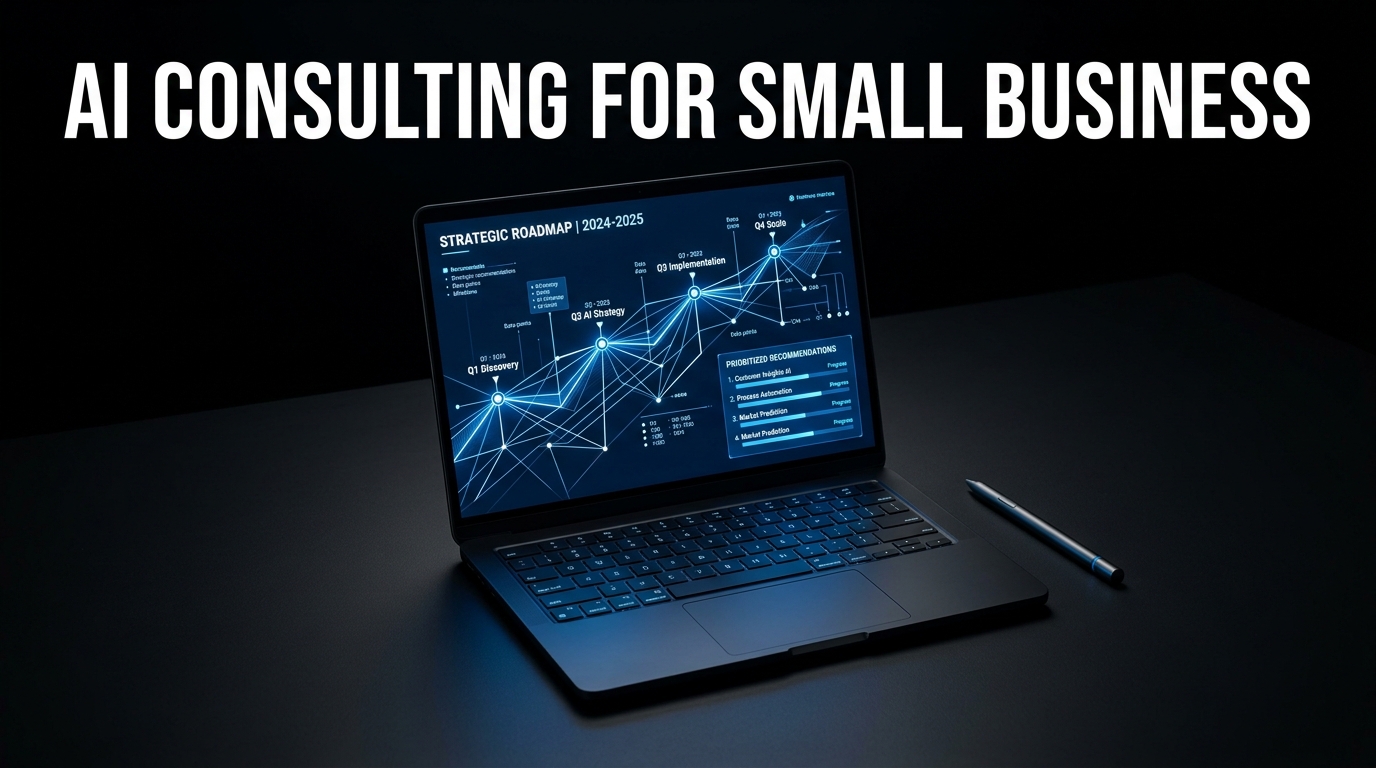
The discovery phase typically culminates in a facilitated session with the business owner or leadership team, working through specific use cases, prioritizing them by realistic impact and feasibility, and producing a practical adoption plan aligned with the business's actual constraints — budget, technical comfort level, existing tools. The final deliverable is usually a prioritized set of recommendations and an implementation roadmap, which either the consultant then executes directly or hands off with clear guidance.
Many consultants start with advisory work — the discovery and roadmap phase alone — and expand into implementation as they build both technical delivery skill and client trust. This hybrid model, selling the strategy and then managing the execution, is one of the fastest-growing service categories in the one-person business economy, because it lets a consultant capture value at both the planning stage and the higher-margin implementation stage of the same client relationship.
What to Actually Charge
Rate structures in 2026 follow a reasonably consistent pattern across the market. Junior consultants, still building a portfolio and case study base, typically charge $100-150 per hour. Mid-level consultants with a defined niche and documented results command $200-350 per hour. Senior specialists — particularly those with recognized backgrounds or deep specialization in a specific generative AI application — reach $400-500+ per hour, with generative AI expertise specifically commanding a 20-30% premium over general AI consulting.
Most consultants start project-based to prove value quickly with a new client, then transition steady, ongoing clients onto monthly retainers once trust and a working relationship are established. This mirrors the broader shift toward value-based pricing for AI-assisted work — pricing the outcome and the ongoing relationship rather than raw hours, which becomes increasingly important as your own delivery speed improves with experience and better tooling.
Getting Your First Clients
Your existing network is the fastest starting point, not a fallback option. Reach out directly to business owners you already know with a specific, concrete message about the exact problem you can solve for their situation — not a generic pitch about AI capabilities in the abstract. Beyond direct outreach, LinkedIn remains the most effective platform for B2B visibility in this category: consistent content about the specific tools and use cases you work with, combined with direct outreach to a defined list of ideal prospects, is a proven and repeatable path to early traction.
Before taking on paying clients, forming an LLC is worth doing early rather than late. Operating as a sole proprietor exposes personal assets to any liability arising from client work, which matters more in this category than in many freelance services because you are frequently working with a client's operational data and automated workflows — an LLC separates personal and business finances and makes it considerably easier to open a business bank account and sign professional contracts with legitimacy.
What I Like / What I Don't Like
What I like: The barrier to entry is genuinely low relative to the income potential — a $100-300/month tech stack against $100-500+/hour billing rates is an unusually favorable ratio for a service business. The gap between small business interest and execution capacity is structural rather than temporary, meaning this is not a narrow window that closes quickly. Vertical specialization within this category compounds meaningfully: the second and third client in the same industry are dramatically easier to close once you have one visible, documented result in that specific vertical.
What I don't like: The credibility problem is real for anyone starting from zero — small business owners are understandably cautious about hiring an unproven consultant for something as consequential as AI adoption, and building the initial case study portfolio often means discounted or unpaid early engagements that do not reflect eventual rates. The category is also attracting a meaningful volume of undifferentiated competitors positioning themselves generically as "AI consultants" with no specific niche or documented results, which makes generic positioning increasingly ineffective even though it remains the default approach most newcomers take. And small business clients frequently have limited internal capacity to sustain adopted workflows after a consulting engagement ends, which means ongoing retainer relationships — not one-off project work — are where the more durable income actually lives.
Bottom Line
AI consulting for small businesses is a genuine solopreneur opportunity precisely because the gap between interest and execution capacity is wide and structural, not a temporary trend. The lean version of this business — a $100-300/month tech stack, a defined industry vertical, and a service package built around discovery, roadmap, and implementation — is accessible without formal AI credentials, provided you build documented, specific proof of results rather than relying on generic positioning.
Who should pursue this now: anyone with genuine hands-on AI tool experience and an existing network that includes small business owners, particularly within a specific industry they already understand well. Who should build the case study portfolio first: anyone with the AI skills but no documented results yet — a handful of discounted or pro-bono early engagements, done well and documented thoroughly, are worth more than jumping straight to full-rate client work with nothing to show.
Join the newsletter for more practical AI workflows and freelance systems.