How to Check an AI SaaS Tool's Churn Rate Before You Promote It (And Why AI Tools Churn Differently)
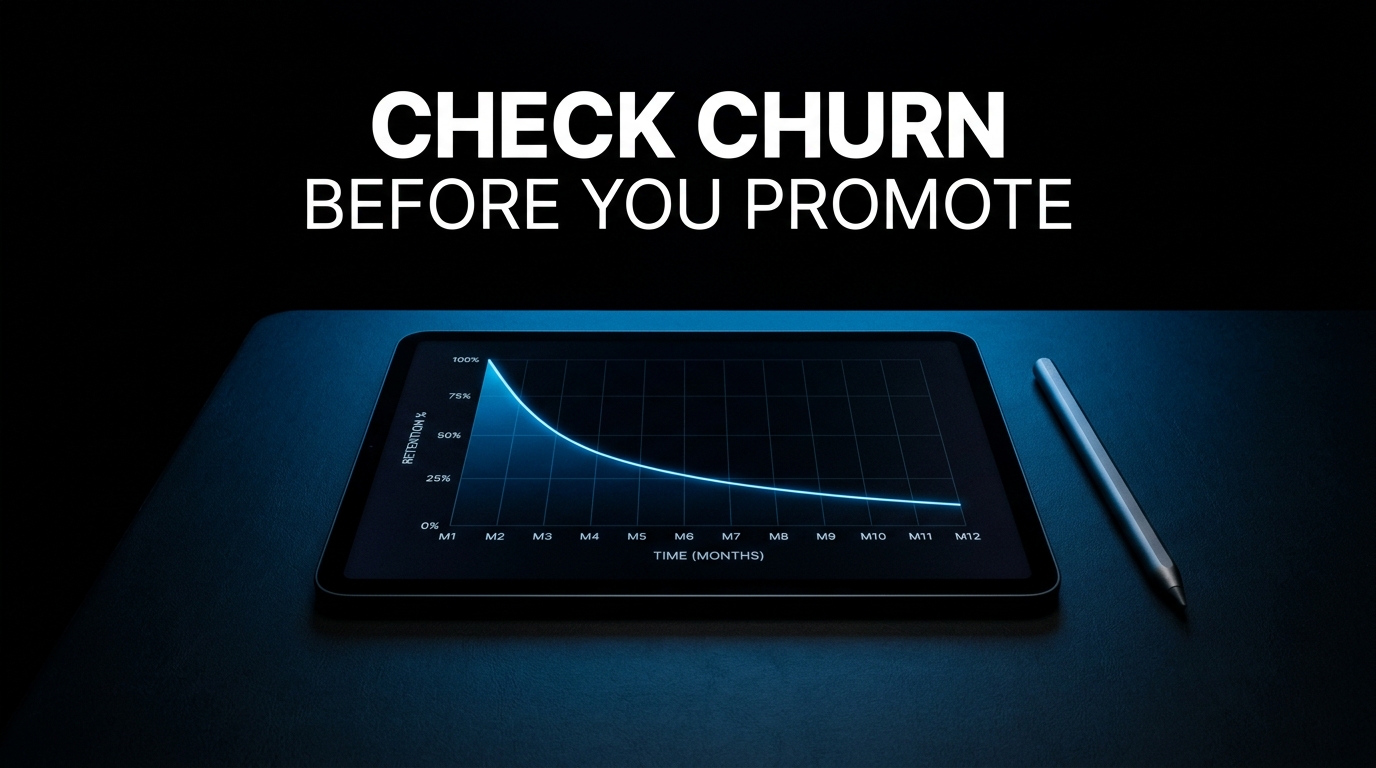
An affiliate promotes an AI writing tool offering 30% recurring commission — a genuinely attractive number on paper. Six months later, checking the actual payouts, the recurring income has quietly dropped to almost nothing. Not because the program changed terms. Because the customers referred months ago already canceled. Budget-tier AI SaaS products priced under $50 a month retain an average of just 23% of users after the first year — meaning roughly three out of four referrals an affiliate sends to a typical low-cost AI tool are gone before the recurring commission has compounded into anything meaningful. This number rarely appears anywhere in a program's affiliate recruiting page.
If you're short on time, here's the key takeaway: AI-native SaaS churns meaningfully faster than traditional SaaS — median gross revenue retention across AI tools sits around 40%, well below the broader B2B SaaS median of roughly 96.5% annual retention. This is largely the "AI tourist" effect: users sign up out of curiosity during a free trial, use a tool once or twice, and cancel before the recurring commission window has any chance to compound. Before promoting any recurring-commission AI SaaS program, check three things: the tool's public reviews for cancellation complaints, its pricing tier (budget tools churn faster than premium ones), and whether the program discloses retention data at all — programs that won't share this are usually hiding a number that would change your decision.
Why This Matters More for AI Tools Specifically Than for Other SaaS
The retention gap between AI-native software and traditional SaaS is not a minor statistical difference — it's structural, and it directly affects the real value of a recurring commission. AI tools acquire a meaningful share of their signups from curiosity rather than genuine need, a pattern the industry has started calling the "AI tourist" effect: someone tries a tool because it's new and interesting, gets a novelty result once, and cancels within the trial or first billing cycle without ever integrating it into a real workflow.
This connects directly to the commission structure analysis in pay-per-conversion affiliate platforms for AI SaaS — a 30% lifetime recurring commission on a tool with 23% annual retention produces dramatically less real income than the headline percentage implies, and no amount of commission structure sophistication fixes a retention problem underneath it.
The Retention Gap Between AI Tools and Traditional SaaS
Gross revenue retention across AI-native SaaS climbed from roughly 27% in early 2025 to about 40% by late 2025 as the initial novelty-driven signup wave settled and products matured — but 40% median retention is still dramatically below the broader B2B SaaS market, where median annual churn sits around 3.5%, meaning roughly 96.5% of customers stay subscribed year over year at a typical established SaaS company. The gap between "40% retained" and "96.5% retained" is the entire difference between a recurring commission that compounds meaningfully and one that evaporates within the first year.
This gap is not uniform across the AI SaaS category. Budget-tier AI products under $50/month specifically retain only about 23% of users — the lowest-retention segment, driven heavily by low-commitment signups and easy cancellation. Higher-priced, more specialized AI tools with genuine workflow integration retain considerably better, closer to traditional SaaS benchmarks, because a tool a business has actually built a process around is far more costly to abandon than a $20/month experiment.
How to Actually Check Retention Before Committing Content Time
Most affiliate programs do not publish churn or retention data directly, which means checking requires some indirect research rather than a single number on a page. Start with independent review platforms — G2, Capterra, or Trustpilot — and read specifically for cancellation patterns in the negative reviews, not just the overall star rating. A pattern of reviews mentioning "canceled after a month," "stopped using it," or "didn't deliver what I expected after the trial" is a much stronger retention signal than the absence of complaints, since most SaaS review platforms skew toward reviews left immediately after signup rather than reviews from long-term users.
Check the pricing tier against the budget-tier retention benchmark directly. A tool priced under $50/month sits in the segment retaining roughly 23% of users annually by default — this alone should discount your expected long-term value of a recurring commission on that tool considerably below the sticker commission rate. A tool priced above $100/month, particularly one marketed toward businesses rather than individual hobbyists, is statistically more likely to have users who've committed budget and workflow integration to it, which correlates with meaningfully better retention.
Ask the affiliate program manager directly for retention or lifetime value data before committing significant content production to a specific program. A program that shares this openly — even directionally, without exact numbers — signals confidence in their retention. A program that deflects or has no answer is a real signal worth weighing, particularly for programs offering unusually generous headline commission rates, since generous commissions are sometimes a way to compensate for retention the company already knows is weak.
The Involuntary Churn Piece Most Affiliates Never Consider
A meaningful share of SaaS churn — 20-40% across the broader market — is involuntary: failed credit card charges, expired payment methods, billing issues that cancel a subscription the customer never actually intended to end. This matters for affiliates because involuntary churn is largely preventable through good billing infrastructure (automatic retry logic, expiration reminders, dunning email sequences) — and a program's investment in solving this is itself a signal worth checking. A company still losing a large share of customers to preventable billing failures either hasn't prioritized retention infrastructure or is newer and less operationally mature, both of which are relevant context before betting recurring content on their program.
What This Means for Which Programs to Actually Promote
None of this means avoiding AI SaaS affiliate programs entirely — it means weighting your content production toward tools more likely to retain the customers you refer. Established AI tools with a genuine workflow use case, priced above the budget tier, with visible signs of retention investment (transparent billing, an active customer success presence, low complaint density around cancellation) are worth prioritizing over newer, cheaper, more aggressively marketed programs offering unusually high headline commissions with no retention track record to back them up.
This is also a case for diversifying which specific programs you build content around rather than concentrating entirely on whichever offers the highest advertised percentage. A portfolio of two or three recurring-commission programs across different retention profiles produces more stable long-term income than betting entirely on the single highest headline rate, precisely because retention data is hard to verify upfront and even careful research can miss a program that turns out to churn faster than expected.
What I Like / What I Don't Like
What I like: The retention gap between AI-native and traditional SaaS is now well-documented enough in 2026 that affiliates have real benchmark numbers to work from rather than guessing — the 23% budget-tier retention figure specifically is a concrete, actionable data point. The involuntary-churn angle is genuinely underweighted in most affiliate due diligence and is one of the more checkable signals available — a program's billing infrastructure quality is visible from customer complaints without needing internal data. Retention across AI SaaS overall is trending upward as the category matures past the initial novelty-signup wave, which is a genuine structural tailwind for anyone building evergreen content now rather than in 2024.
What I don't like: Retention data remains genuinely difficult to verify with precision from outside a company — review-platform research and program manager questions are directional signals, not hard numbers, and a careful affiliate can still commit to a program that turns out to churn worse than the available signals suggested. The budget-tier retention benchmark, while useful, is an average across a wide category — some genuinely excellent tools sit at low price points with retention well above the 23% median, and the benchmark alone shouldn't be the sole disqualifying factor for a specific program. And programs with the worst retention have no incentive to make that information easy to find, which means the affiliates who most need this data are the ones least likely to get a straight answer when they ask for it.
Bottom Line
A recurring commission is only worth what the customer actually stays subscribed to pay. For AI SaaS specifically, the retention baseline is meaningfully worse than traditional SaaS — averaging around 40% overall and as low as 23% for budget-tier tools — which means the headline commission percentage on an AI SaaS affiliate program tells you considerably less about actual expected income than it would for a more mature software category.
Who should run this check before committing content: any affiliate about to build a comparison article, review, or evergreen guide promoting a specific AI SaaS tool's recurring commission program. Who can deprioritize this level of scrutiny: affiliates promoting flat one-time payout programs, where retention after conversion doesn't affect the commission already earned.
Join the newsletter for more practical AI workflows and affiliate marketing systems.