AI Self-Publishing Tools in 2026: The Honest Breakdown of What the Market Gets Wrong and What a Solo Publisher Actually Needs
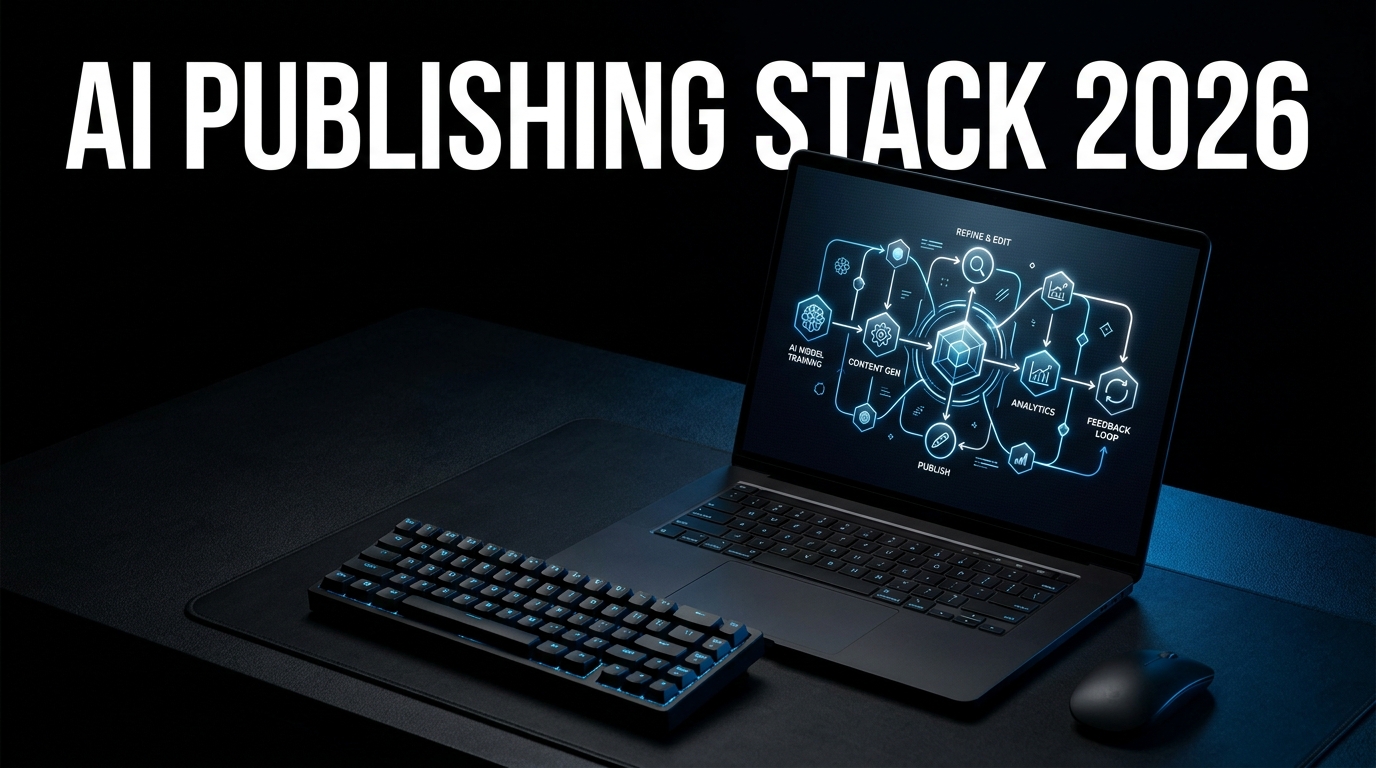
Most "best AI self-publishing tools" lists are shopping guides disguised as advice. They rank tools by feature count, include affiliate links to everything, and never answer the question a solo publisher actually needs answered: does this tool produce a KDP-compliant file at the end, or does it hand you a pile of text that still needs three more apps to become a published book? The bottleneck in AI-assisted self-publishing in 2026 is not the writing. It is the gap between generating content and having something Amazon will accept. That gap is where most solo publishers waste their time — and where most tool lists quietly stop helping.
If you're short on time, here's the key takeaway: A solo publisher in 2026 needs four things from their tool stack: niche validation before writing, a drafting layer that produces structured output section by section, a cover that reads at thumbnail size, and a KDP-compliant export in EPUB or DOCX. Most AI writing tools handle one of those four. A few handle all of them. The sequence matters as much as the tools — and most publishers get the sequence wrong.
Why the Market Gets This Wrong
The most common mistake solo publishers make when adopting AI tools is starting with the writing phase and skipping the research phase entirely. That sequence error costs more than any tool choice. A book written quickly but aimed at a niche with no buyer demand produces nothing. AI does not solve a positioning problem — it amplifies whatever system sits underneath it.
The second mistake is confusing a content generator with a publishing workflow. Someone writes 40,000 words in ChatGPT prompts over six weeks. The content is good enough. The structure is not. There is no table of contents that works on Kindle apps, no front matter, no trim-size-correct formatting, no cover at the right resolution. They have content, not a book. They have AI, not a workflow.
A multi-tool DIY stack — AI writer at $39–$99/month, formatter at a one-time $147, cover tool at $15–$30/month — runs $144–$371 per book and requires moving files between apps that do not talk to each other. That patchwork is where quality dies and where most solo publishers quietly give up. The AI self-publishing stack for solo creators starts with understanding what each stage actually requires before picking any tool.
The Four Stages That Actually Matter
Strip away the marketing and every useful self-publishing tool in 2026 serves one of four stages. The order is not negotiable.
Stage 1 — Niche research. This is where publishing income is won or lost before a single word is written. The right tool at this stage tells you whether a niche has buyer demand, how competitive it is, and which keywords will determine whether Amazon's algorithm surfaces your book. Publisher Rocket and BookBeam are the purpose-built options here — both translate live Best Sellers Rank data into estimated monthly sales figures. Perplexity AI is a usable free alternative for initial validation. None of the all-in-one AI writing platforms handle this stage well. If your stack does not start here, it does not start correctly.
Stage 2 — Manuscript drafting. Claude is currently the strongest tool for long-form structured drafting among the general-purpose AI models. The output reads more like human writing, follows complex structural instructions reliably, and holds consistency across chapters in a way that ChatGPT does not always maintain at scale. The correct workflow is drafting chapter by chapter with specific prompts for each section — not generating the entire manuscript in a single prompt. What stands out about the publishers building real KDP portfolios is that they treat the AI as a drafting assistant that needs direction, not a system that produces finished output unsupervised. You still need to edit for factual accuracy, remove repetitive phrasing, and rewrite the introduction in your own voice.
Stage 3 — Cover design. Your cover sells your book. On Amazon, it displays at around 100 pixels wide in search results. A cover that does not read clearly at thumbnail size is a conversion killer regardless of what the content looks like. Ideogram.ai currently produces the most reliable AI-generated cover concepts with functional text rendering — a meaningful advantage over Midjourney and Flux for cover work where the title needs to be legible. Canva remains a solid option for creators who want more control over typography and layout using their own design instincts on top of an AI-generated background image.
Stage 4 — KDP-compliant export. Amazon KDP accepts EPUB, DOCX, and KPF for manuscripts, plus a JPG or TIFF cover at minimum 1600x2560 resolution. EPUB is the cleanest format. Most AI writing tools do not export EPUB. This is not a minor gap — it means every tool that stops at "here is your text" requires at least one more step before you can upload anything. Tools that handle end-to-end export — manuscript plus cover at KDP dimensions — eliminate that friction at the cost of being more opinionated about the workflow.
What the All-in-One Platforms Get Right and Wrong
A pattern I'm seeing in 2026 is genuine consolidation in the market. All-in-one platforms are replacing multi-tool stacks for solo publishers who want to reduce friction. The appeal is real — handling writing, formatting, cover design, and export from a single interface removes the file-moving overhead that kills momentum between sessions.
The tradeoff is flexibility. All-in-one tools make opinionated choices about workflow structure, and those choices do not always match how a particular genre or niche is best served. A literary fiction writer needs different prompting support than someone building a portfolio of personal finance workbooks. A platform optimised for one category may actively get in the way of the other.
The honest assessment: for a solo publisher building a KDP portfolio in structured nonfiction categories — workbooks, guides, how-to books, activity books — an all-in-one platform that handles research, drafting, cover, and EPUB export is genuinely worth evaluating. For fiction, or for publishers who already have a clear niche strategy and want maximum control over the output, the layered stack approach with Claude for drafting, Ideogram for covers, and Reedsy or Atticus for formatting produces better results at the cost of more complexity.
What You Can Actually Skip
The majority of tools in the AI self-publishing category can be skipped without meaningful impact on your publishing output. Most AI writing platforms — Jasper, Writesonic, Copy.ai — were built for marketing content and expanded awkwardly into book writing. They handle chapters of 500–800 words comfortably and produce inconsistent output at chapter 12 of a 20,000-word manuscript. For self-publishing specifically, they are the wrong tool for the job regardless of their feature list.
Dedicated formatting tools like Vellum and Atticus produce excellent output but require you to arrive with a complete, edited manuscript. They do not compress the production timeline for someone who is still generating content. They belong at the end of the workflow, not the beginning. If you are at the stage where you need Vellum, your stack is already working. If you are not yet consistently producing manuscripts, formatting software is a premature investment.
Grammarly and ProWritingAid are useful as a final editing pass but are not the constraint. The constraint is almost never grammar. It is structural quality, niche specificity, and the gap between AI output and something a reader will find valuable enough to not return.
What I like: The consolidation trend is genuinely useful for solo publishers. A single platform that handles research, drafting, cover, and export removes the multi-app friction that killed more KDP ambitions than bad niche choices ever did. Claude's manuscript drafting quality is meaningfully ahead of alternatives for structured nonfiction, and the cost at $20/month for Pro is easy to justify at even one published title per month. The free tier of most tools is sufficient to test the workflow before committing money.
What I don't like: Most tool lists are written by affiliates, not publishers. The "best" recommendation often correlates directly with the commission rate, not the output quality. The category is also maturing fast enough that any specific tool comparison is partially outdated within six months. What matters more than any specific tool is understanding the four stages — research, drafting, cover, export — and having something that handles each one. The specific software inside each stage is less important than the sequence.
Bottom Line
The AI self-publishing tool market in 2026 has more options than any solo publisher needs and fewer genuinely useful ones than the lists suggest. The publishers building real KDP income are not using the most tools — they are using the right ones in the right order. Research first. Draft chapter by chapter. Cover at thumbnail size. Export KDP-compliant files. Everything else is optional.
Who should invest in an all-in-one platform: solo publishers building structured nonfiction portfolios who want to reduce workflow friction and are willing to work within a more opinionated system. Who should build a layered stack: publishers with a clear niche strategy who want maximum control, or anyone writing fiction where narrative consistency matters more than production speed.
Start with the research stage. If you do not know whether your niche has buyer demand before you write the first chapter, no tool choice will compensate for that.
Join the newsletter for more practical AI publishing and digital product workflows.