KDP Select vs Wide Distribution in 2026: The Decision Framework That Actually Tells You Which One to Choose
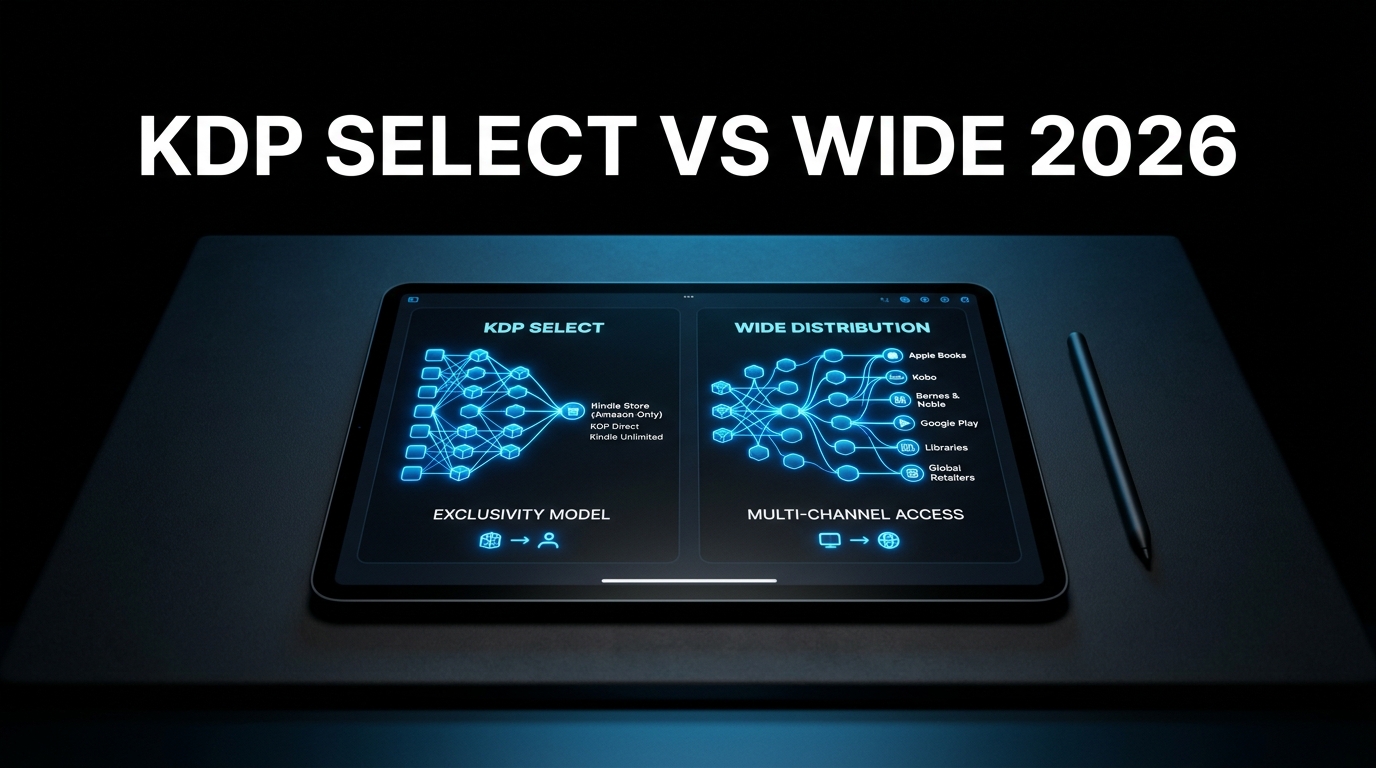
Most self-publishers approach the KDP Select vs wide distribution decision the wrong way. They read forum threads full of conflicting opinions, pick a side based on whoever argued most convincingly, and stick with it indefinitely regardless of results. The decision is not a matter of opinion. It is a function of four specific variables — genre, audience, catalog size, and income goal — and once you know how those variables apply to your specific situation, the answer becomes straightforward. What makes this decision consequential is the 90-day exclusivity lock-in. Choose Select and you cannot sell your ebook anywhere else for three months. Choose wide and you lose access to Kindle Unlimited's subscriber base and Select's promotional tools for the same period. There is no cost-free way to test both simultaneously.
If you're short on time, here's the key takeaway: KDP Select wins for genre fiction in KU-dominant categories — romance, LitRPG, cozy mystery, fantasy — where 60–80% of top-ranking titles carry the Kindle Unlimited badge. Wide distribution wins for nonfiction, where a 200-page book read at 40% completion in KU earns roughly $0.36 versus $6.99 at a $9.99 direct sale. For solo publishers building a nonfiction portfolio with AI, wide distribution is almost always the better long-term strategy. The decision framework below makes this concrete for your specific situation.
How KDP Select Actually Works (And What Most Guides Skip)
KDP Select is not the same thing as Kindle Unlimited. Authors enroll in Select — readers subscribe to Kindle Unlimited. Your enrollment in Select makes your ebook available to KU subscribers, who can read it at no additional cost. You earn based on pages actually read, not downloads.
The payment mechanics matter more than most guides acknowledge. Amazon sets a monthly Global Fund — historically $500–550 million globally. Pages are standardized using KENPC (Kindle Edition Normalized Page Count). The payout per page fluctuates monthly; in May 2026 the US rate was approximately $0.0048 per page. A 200-page nonfiction book fully read earns roughly $0.96. The same book sold at $9.99 earns $6.99 at the 70% royalty rate.
That arithmetic is the core of the nonfiction problem with KDP Select. Nonfiction readers rarely read books cover to cover — a 40% completion rate is common for practical guides. At 40% completion on a 200-page book, your KU earnings are approximately $0.36. At a $9.99 direct sale, you earn $6.99. The gap is not marginal — it is a 19x difference in revenue per reader. If your book is in a category where readers prefer to own and reference rather than borrow and binge, KU mechanics work against you.
In exchange for exclusivity, Select provides three meaningful tools: access to KU page-read income, Kindle Countdown Deals (time-limited discounts that maintain the 70% royalty rate), and up to 5 Free Book Promotion days per 90-day enrollment period. These tools are most valuable when your category has high KU penetration and when you have a series where free promotions on Book 1 drive paid purchases of Books 2, 3, and 4. For standalone titles in nonfiction categories, their value drops significantly. For the full context on where this fits in your AI self-publishing stack, the architecture matters as much as the distribution decision.
The Four Questions That Decide the Answer
Run these four questions against your specific publishing situation before making any decision.
Question 1: What percentage of top-ranking books in your target category carry the Kindle Unlimited badge? This is the single most important data point. Go to Amazon, search your target category, and count how many of the top 20 results show the "Read for Free" KU badge. If 15 or more do, your category has high KU penetration and KDP Select is likely the correct choice — readers in your category expect to find books through KU, and being absent from it makes you invisible to a large segment of your potential audience. If fewer than 10 do, wide distribution is worth serious consideration.
Question 2: Is your book part of a series or a standalone? KDP Select's promotional mechanics compound for series. A Free Book Promotion on Book 1 drives KU borrows and paid purchases of subsequent books. Wide distribution's income advantage compounds with catalog size — wide authors in surveyed data report 34% higher average monthly income than Amazon-exclusives, and the advantage grows as the catalog grows. For a standalone nonfiction title, wide distribution's income math is almost always superior.
Question 3: Do you have an existing audience or email list? Wide distribution's income advantage assumes you can drive traffic to multiple storefronts. If you have no existing audience and are relying entirely on platform discovery, KDP Select's Amazon algorithm leverage is more valuable than access to Apple Books or Kobo where you have no visibility. A beginner with no list, no platform, and no traffic strategy will often do better starting with KDP Select — not because the economics are superior, but because focused execution on one platform outperforms scattered execution across five.
Question 4: What is your primary income goal — short-term momentum or long-term resilience? KDP Select is a concentrated growth model. Wide distribution is a diversification model. KDP Select gives you algorithmic leverage and KU income now, at the cost of platform dependency. Wide distribution builds income streams across Apple Books, Kobo, Google Play, and library systems that are not subject to Amazon's algorithm changes, making your income more resilient over time.
What the Genre Data Actually Shows
The genre breakdown is clearer than the forums suggest. For fiction in KU-dominant categories — romance, LitRPG, cozy mystery, epic fantasy, military sci-fi — KDP Select consistently delivers the majority of high-earning authors' income through page reads. In these genres, 60–80% of top-100 titles carry the KU badge. A book that is not in KU in these categories is invisible to the segment of the readership that exclusively uses KU subscriptions.
For nonfiction — practical guides, workbooks, how-to books, business books — the picture inverts. Readers in these categories prefer to own and reference books rather than borrow and binge them. Library channels (OverDrive, Libby) represent meaningful distribution for nonfiction that KDP Select blocks entirely. Apple Books has a disproportionately strong nonfiction readership outside the US, particularly in Canada, Australia, and Western Europe. Kobo has a strong international footprint that matters for nonfiction creators with global audiences.
The practical test: search your target subcategory on Amazon and run the badge count. If your subcategory shows 70 or more KU titles in the top 100, Select is likely your higher-ceiling path. If it shows fewer than 40, wide distribution deserves serious evaluation before you lock into a 90-day exclusivity term.
The Hybrid Approach Worth Considering
A pattern I'm seeing among solo publishers building AI-assisted portfolios is a structured hybrid — starting new titles in KDP Select for the first 90 days to build initial reviews and ranking momentum, then going wide on renewal if the KU income does not justify continued exclusivity. This approach uses Select's promotional tools during the period when you most need algorithmic visibility, then diversifies once the title has social proof.
The risk is the auto-renewal default. KDP Select automatically renews for another 90-day term if you do not opt out before the renewal date. Missing that window locks you in for another quarter. If you use the hybrid approach, calendar the opt-out date the moment you enroll. This is one of the most common and avoidable mistakes in KDP Select management. Understanding this alongside how to build a KDP ebook portfolio with AI gives you the complete strategic picture before committing to either path.
What I like: The decision framework here is genuinely more useful than the "it depends" non-answer that dominates most guides. The badge-count test gives you a concrete data point before you commit. Wide distribution's income advantage for nonfiction is well-documented and significant enough to be decisive for most solo publishers building AI-assisted nonfiction portfolios. The 34% higher average monthly income reported by wide authors compounds meaningfully across a catalog of 10 or more titles.
What I don't like: The 90-day lock-in with auto-renewal creates real friction for publishers who want to test both approaches. Amazon's Global Fund fluctuates monthly, making KU income less predictable than royalty income from direct sales. And the operational complexity of managing wide distribution across Apple Books, Kobo, Google Play, and library aggregators — even with tools like Draft2Digital handling the distribution — is a real overhead that a solo publisher needs to account for honestly.
Bottom Line
For solo publishers building a nonfiction portfolio with AI assistance — the core SimonValue reader — wide distribution is almost always the better long-term strategy. The income math on nonfiction in KU does not compete with direct sales at a $9.99 price point. The library channel access and international platform diversification add meaningful revenue that KDP Select blocks. And the platform dependency risk of Amazon exclusivity compounds as your catalog grows.
For fiction authors in KU-dominant categories, KDP Select is the right starting point. The badge-count test will confirm this quickly. If your subcategory is dominated by KU titles, opt out of wide distribution until you have the catalog depth and audience to drive meaningful traffic to non-Amazon platforms independently.
Run the four questions. Do the badge-count test. Make the decision based on your specific genre and audience, not on forum consensus.
Join the newsletter for more practical AI publishing and digital product workflows.