Perplexity vs ChatGPT for Research: Which to Use
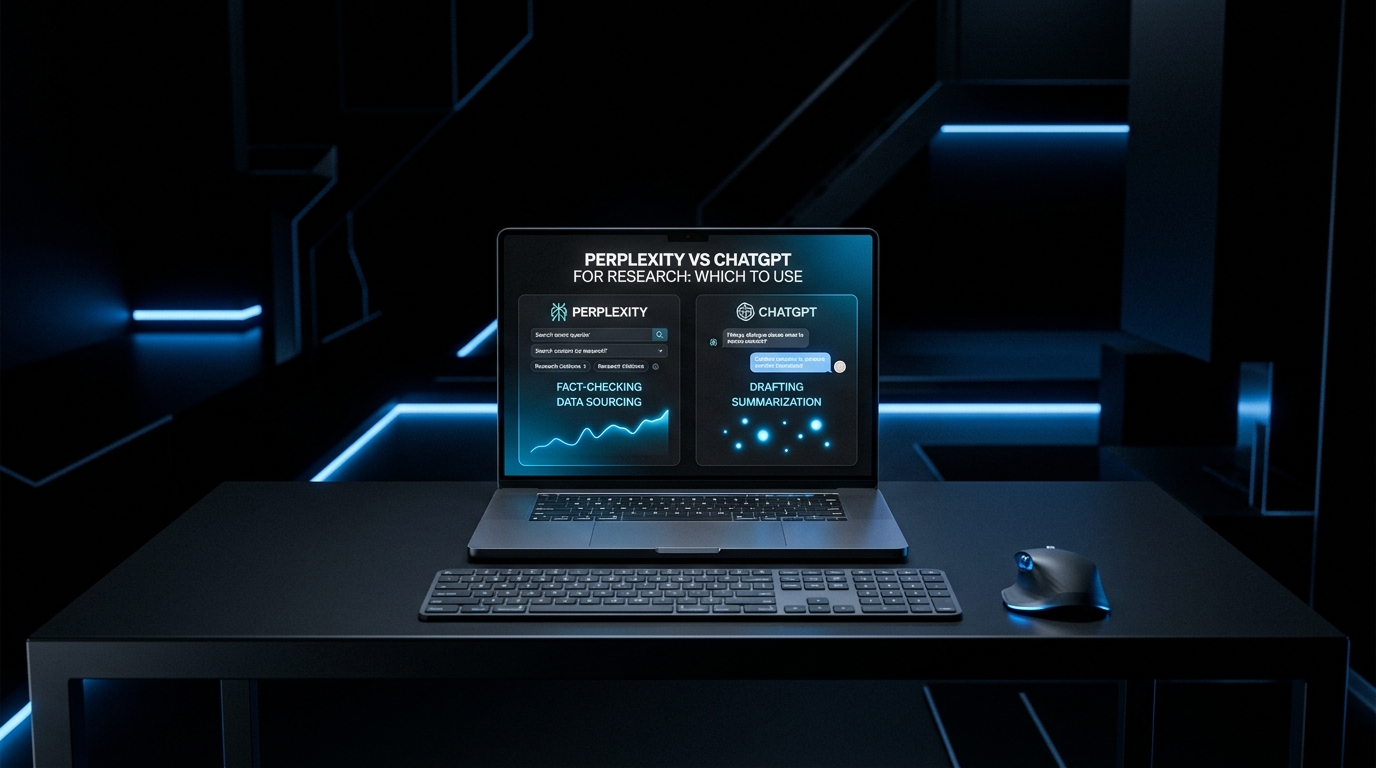
Most solo creators pick one AI tool and use it for everything. They default to ChatGPT because it's familiar, then wonder why their research feels thin, their sources are vague, or their fact-checks keep coming back wrong. The real problem isn't the tool — it's using the wrong tool for the task. Perplexity and ChatGPT are not competitors fighting for the same job. They're built differently, optimized differently, and reward different use cases. If you're publishing — blog posts, digital products, newsletters, social content — getting this wrong costs you credibility. Getting it right saves hours per week.
If you're short on time, here's the key takeaway:
Quick Take: Perplexity wins for fast, cited, factual research. ChatGPT wins for deep analysis, synthesis, and creative tasks that build on research. For solo creators who publish regularly, the smartest move is using both — one to gather verified facts, one to build content around them.
Why This Matters for Creators Who Publish
This isn't an abstract debate for tech reviewers. It's a workflow decision with real consequences. If you're building digital products fast or writing content that needs to hold up under scrutiny, the tool you use for research directly affects quality, speed, and trust.
Both tools fetch live web data, but Perplexity cites sources by default, whereas ChatGPT decides whether to do a real-time search or not based on the prompt. That's a meaningful difference when you're working at speed and can't manually verify every claim.
And the stakes are rising. Perplexity has moved past the "AI search toy" phase and is now behaving like a product family with distinct modes, verticals, and enterprise controls. Ignoring it in 2026 means working harder than you need to.
What Most Creators Get Wrong About These Two Tools
The common mistake is treating both tools as interchangeable chatbots. They're not. Perplexity is a retrieval-first answer engine built from the ground up for real-time web search with inline citations — best for research, fact-checking, and anyone who needs verifiable answers fast. ChatGPT is a generation-first conversational AI with an enormous feature surface — search, image generation, voice mode, coding, agents, and a plugin ecosystem — ideal as an all-purpose AI assistant.
A pattern I'm seeing with creators who publish consistently: they use ChatGPT to research, get a confident-sounding answer with no sources, publish it, and then get called out in the comments. Both can hallucinate, so fact-checking is a must — but Perplexity at least shows you where to check.
Practical example: you're writing a post on AI tools for your niche (something like the top AI tools for digital product creators). Use Perplexity first to pull current data with citations. Then hand those verified facts to ChatGPT to build structure, narrative, and persuasion around them. Two steps. Much stronger output.
How Each Tool Actually Performs on Specific Research Tasks
Fact-checking and current data: Perplexity has a clear edge. In independent benchmarks, Perplexity achieved 92% factual accuracy on real-time queries versus ChatGPT's 87%, with a citation error rate nearly half that of ChatGPT Search. For anything date-sensitive — pricing, tool features, market trends — that gap matters.
Deep analysis and synthesis: ChatGPT pulls ahead. For a full breakdown of how to build your AI research and writing stack as a solo creator, the AI Tools for Digital Creators guide covers exactly how these tools fit together. ChatGPT is pushing toward a broader vision of agentic AI. It is not limited to information gathering. When you need to take raw research and turn it into a sales page, an email sequence, or a full product outline, ChatGPT's generation ability and long context handling are genuinely superior.
Niche research for digital products: Perplexity is evolving into a highly capable research agent. When asked to investigate a topic, compare sources, validate claims, or gather information from across the web, it performs surprisingly well. It does not simply provide an answer; it actively searches, analyzes multiple sources, cites references, and presents findings in a structured format. This is exactly what you need when validating a niche idea before committing to a product.
Content creation: ChatGPT wins without contest. ChatGPT is better at creative content, coding, and conversation in 2026. Drafting, rewriting, structuring, tone-matching — all of it is smoother in ChatGPT's environment.
What's New in 2026 That Changes the Equation
Perplexity has shipped several meaningful upgrades recently. Perplexity has shipped 10 meaningful features since December 2025, including a smarter memory engine, scheduled searches that run without you, SEC-linked financial data, and connectors that pull live context from Gmail, Slack, and Google Drive.
The one worth paying attention to for research-heavy creators: Model Council launched on February 5, 2026. It lets you run a single query through three different AI models at the same time. You see all three responses and can compare them. That's a legitimate quality control layer built directly into the tool.
On the ChatGPT side, the latest advanced AI models handle complex reasoning tasks and break down multi-step problems, providing detailed explanations. For creators building things like conversion-focused sales pages or email sequences that require layered reasoning, this reasoning upgrade is genuinely useful.
Pricing is identical at the base paid tier — ChatGPT Plus and Perplexity Pro both sit at $20 per month — so running both is a real option for anyone serious about publishing quality content.
What I Like / What I Don't Like
What I like:
— Perplexity is structurally ahead on citations. Every answer ships with numbered footnotes that link straight to the source URL. For anyone publishing, that's trust infrastructure built in.
— ChatGPT's ability to hold long context and iterate on drafts inside one session is still unmatched for content production workflows.
— Perplexity's memory engine now recalls the right context 95% of the time, and scheduled searches turn it from a tab you open into a system that runs for you.
— Both have free tiers, so there's no reason not to test the split-workflow approach before committing.
What I don't like:
— ChatGPT still feels inconsistent about when it actually runs a web search vs. pulling from training data. You have to prompt carefully.
— Perplexity's interface is not built for long-form content creation. It's a research tool, not a writing environment, and fighting that design friction wastes time.
— The two-tool workflow adds cognitive overhead for creators who are already juggling too many tabs. There's a learning curve to making it feel natural.
Frequently Asked Questions
Does Perplexity use ChatGPT?
No, Perplexity is a separate product from ChatGPT. It does offer some OpenAI models, the family behind ChatGPT, alongside its own Sonar model and models from other providers. Which one answers depends on your plan and on whether you leave the selector on Best.
After checking Perplexity's own Help Center, what stands out is how mixed the list is. As of its September 2026 snapshot, paid plans list Perplexity's Sonar 2, OpenAI's GPT-5.6 models, Google's Gemini 3.7 Flash and Anthropic's Claude Sonnet 5, plus models from other companies. On the Free plan you can use Best but cannot pick a model manually. Perplexity also says the list changes as providers release new models, so check the model selector in your own account before you rely on a specific one.
For research work the practical point is simple: Perplexity is the tool that searches and cites sources, and the model behind it is only one part of that. If you want to see whether the choice changes your results, run the same question on two or three models and compare the sources each one returns.
Bottom Line
Stop asking which tool is better. Start asking which tool is right for which task. Perplexity searches and cites. ChatGPT thinks and creates. For solo creators who publish consistently, both belong in your workflow.
Use Perplexity first when the work is fact-sensitive — market research, trend validation, competitor pricing, current tool features. Use ChatGPT to build the thing: the outline, the draft, the sequence, the sales copy.
If you can only use one: Perplexity is the safer default for research accuracy. ChatGPT is the better default for content production. Pick based on where your current bottleneck actually lives.
Skip the split workflow if you're still in ideation mode and accuracy doesn't matter yet. But the moment you're publishing anything intended to convert or inform — you want verified sources in your corner.
Join the newsletter for more practical AI workflows at SimonValue.com/newsletter.