How to Reduce Refund Requests on Digital Products With AI (Without Killing Conversions)
Most solo creators selling digital products have no idea what their actual refund rate is. They notice refunds when they happen, feel a small sting each time, and move on without ever calculating the percentage or asking why it happened. A healthy digital product refund rate sits at 1-2% of sales. If yours is running at 5% or higher, something specific and fixable is broken in your funnel — and it's very rarely the product itself. It's almost always what happens, or doesn't happen, in the first three days after someone pays.
If you're short on time, here's the key takeaway: Most digital product refunds aren't about product quality — they're about a gap between what the buyer expected and what they experienced in the first 72 hours after purchase. The fix isn't a stricter refund policy or better gatekeeping. It's proactive onboarding: a clear "here's exactly what to do first" sequence, a fast response to early confusion, and catching hesitation before it hardens into a refund request. AI genuinely helps here by making that follow-up fast and consistent — but the framework matters more than the tool.
Why Refunds Happen More Often Than the Product Deserves
The instinct when a refund request comes in is to take it personally, as a verdict on quality. Most of the time that's the wrong read entirely. A buyer who requests a refund three hours after purchase almost never did so because they thoroughly evaluated the content and found it lacking — they usually hit a moment of friction (confusion about how to access something, uncertainty about where to start, a nagging doubt about whether they made the right call) and the path of least resistance was asking for their money back rather than working through it.
This connects directly to a gap covered in the AI-assisted digital product launch checklist — the post-purchase sequence is one of the steps solo creators consistently skip because it produces no visible progress before launch, and it's exactly the step that determines whether early friction turns into a refund or gets resolved before it escalates.
The 72-Hour Window That Decides Most Outcomes
The period immediately after purchase is when a buyer's excitement and attention are highest, and it's also when their tolerance for friction is lowest — any confusion here reads as a bigger problem than it actually is, precisely because expectations were just set at their peak. A delayed or generic delivery experience quietly starts the countdown toward a refund request well before the buyer has genuinely evaluated the content.
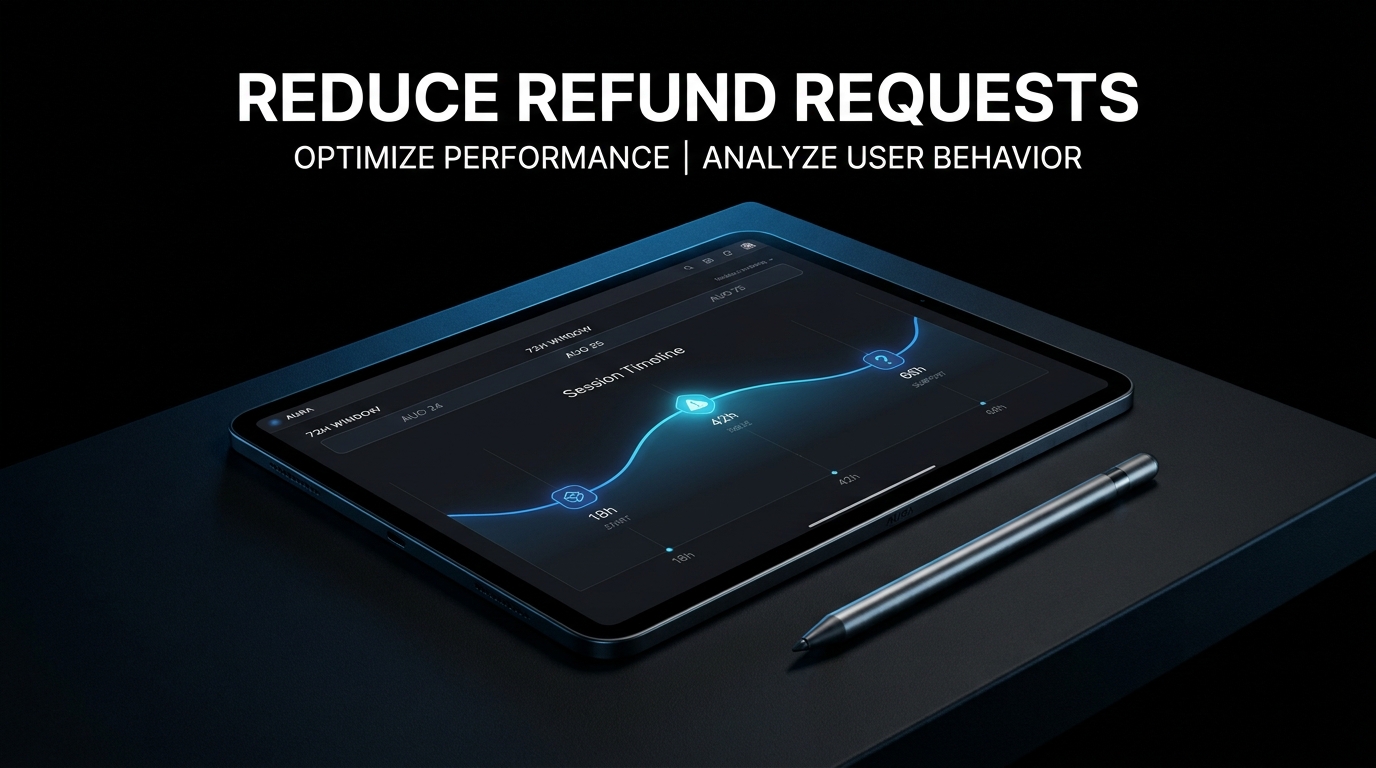
The fix is a specific, proactive sequence rather than a passive "here's your download link" email. Within the first hour: confirm access clearly and tell the buyer exactly what to do first — not everything the product contains, just the single next step. Within 24 hours: a check-in that reinforces the outcome they're working toward, not a generic "how's it going." Within 72 hours: a direct question — are you stuck anywhere — sent before hesitation has had time to calcify into a refund decision. This single pattern, sent consistently, catches the buyers who would otherwise quietly disengage and resurface later with a refund request instead of a solvable question.
Where AI Actually Helps (And Where It Doesn't)
AI's genuine contribution here is speed and consistency, not sophistication. A solo creator without AI assistance either sends this sequence manually to every buyer — which doesn't scale past a handful of sales a week — or skips it entirely once volume increases, which is exactly the pattern that lets refund rates creep up unnoticed. An AI-drafted, automated version of this sequence, triggered by purchase and tuned to your specific product's common friction points, runs at any volume without your daily involvement.
What AI cannot do is replace the judgment about what the actual friction points are for your specific product. That requires you to have actually looked at why refunds happen — which section confuses people, which step gets skipped, which promise felt oversold at the sales page stage — and fed that specific knowledge into the sequence. An AI-drafted generic "we're here if you need anything" message performs barely better than no message at all. A sequence built around your product's three most common confusion points, drafted with AI assistance but informed by real refund reasons you've actually collected, performs meaningfully better.
Setting Expectations Before the Sale, Not After
A significant share of refund requests trace back not to the delivery experience but to a mismatch created at the sales page itself — a promise that oversold the outcome, or vague language that let the buyer imagine something more comprehensive than what actually exists. This is a launch-stage problem, not a post-purchase problem, and it's worth being honest about: no onboarding sequence, however well-built, fully compensates for a sales page that created expectations the product can't meet.
The practical fix is specificity at the point of sale rather than after it. State clearly what the product includes and, just as importantly, what it doesn't — a buyer who knows exactly what they're getting before paying is a buyer who doesn't feel misled three days later. This is the same discipline covered in validating a mini-course idea before building it — a specific, honest promise that matches what actually gets delivered converts fewer curiosity clicks but produces a meaningfully lower refund rate, which is a better trade for a solo creator than a broader promise that inflates initial sales at the cost of later refunds.
Where to Actually Disclose the Refund Policy
Refund policy placement matters for two separate reasons: it affects buyer trust and conversion at the point of purchase, and it matters for dispute defense if a payment platform or bank ever asks whether the customer had clear access to the policy before paying. A one-line summary near the payment button on the checkout page, a repeated mention in the order confirmation email, a reminder inside the onboarding sequence — especially in the first few days when the refund window is still open and top of mind — and a dedicated policy page linked from your help documentation all serve this dual purpose. Skipping this doesn't just create a support headache later; it removes your ability to push back credibly if a buyer disputes a charge rather than requesting a straightforward refund.
On refund window length: 30 days is the standard for most digital products, but a shorter 7-14 day window makes more sense for content-heavy courses where completion or meaningful engagement can reasonably be expected within that timeframe — a shorter window here isn't stinginess, it's aligning the policy with how the product is actually meant to be consumed.
What to Do When a Refund Request Actually Arrives
Even with strong onboarding, some refund requests are legitimate and some are unavoidable regardless of what you build. The response pattern that keeps a customer engaged rather than hardening their frustration is an exchange-first approach: before processing the refund immediately, ask a specific, genuine question about what didn't work, and offer an alternative if one plausibly addresses the actual issue — a different resource, a direct answer to whatever they were stuck on, an extension if time was the constraint. This isn't about making refunds harder to get. It's about not letting a solvable moment of confusion default straight to a refund when a two-minute conversation might have resolved it instead.
The response pattern that reliably makes things worse is a delayed, generic acknowledgment that leaves the customer to sit with their frustration before hearing back. A slow or impersonal response to a refund request doesn't just process one refund — it often turns a mildly frustrated customer into one who leaves a negative review or disputes the charge directly with their bank instead of working with you.
What I Like / What I Don't Like
What I like: The 72-hour onboarding framework is genuinely actionable and doesn't require sophisticated tooling to implement — even a simple three-email automated sequence, drafted once and triggered by purchase, catches a meaningful share of the friction that would otherwise turn into refund requests. The exchange-first response pattern for actual refund requests is a real, low-cost improvement over defaulting straight to a refund the moment someone asks. Treating the refund rate as a measurable number worth tracking, rather than an emotional event to feel bad about individually, is the mindset shift that actually leads to fixing the underlying causes.
What I don't like: None of this fully compensates for a sales page that oversold the product in the first place — a mismatch created at the point of sale is genuinely harder to undo after purchase than to avoid by being specific upfront. Most refund-reduction content online is written for e-commerce and physical product returns, and translating it to digital products requires filtering out logistics-specific advice (shipping, chargebacks on physical goods) that doesn't apply. And building a good onboarding sequence requires actually knowing why your specific product generates refunds — which means collecting and reviewing real refund reasons rather than guessing, a step many solo creators skip because it's mildly uncomfortable to look at closely.
Bottom Line
A digital product refund rate above 2% is usually not a verdict on product quality — it's a signal that something specific and fixable is happening in the gap between the sales page promise and the first 72 hours of the buyer's actual experience. The fix is not a stricter policy or slower refund processing. It's proactive, specific onboarding that catches confusion before it hardens into a refund request, paired with honest expectation-setting at the point of sale so buyers aren't surprised by what they receive.
Who should audit this now: any solo creator who has never actually calculated their refund rate as a percentage, or who processes refund requests immediately without asking what went wrong first. Who can deprioritize this: creators already tracking refund rate below 2% with a documented onboarding sequence already running — the marginal improvement available here is smaller once the basics are already in place.
Join the newsletter for more practical AI workflows and digital product systems.