Sell Digital Products With an Evergreen Funnel
Most digital product creators treat a launch like a finish line. They spend weeks building buzz, writing promo emails, and running a cart-open window — then watch sales flatline the moment it closes. The result? Feast-or-famine income that depends entirely on your next launch. A pattern I'm seeing more of in 2026 is operators quietly stepping off the launch treadmill altogether. Not because launches are broken, but because there's a smarter system running underneath — one that sells while you sleep, without the cart-close panic or the social media sprint. That system is an evergreen funnel. And most people are either missing it entirely, or building it wrong.
Quick Take
If you're short on time, here's the key takeaway: an evergreen funnel is an automated sequence — lead magnet, email nurture, sales page, timed offer — that sells your digital product to every new subscriber on autopilot. There's no need for launches, live webinars, or constant promotion. You build it once, drive traffic to it consistently, and it handles conversion for you around the clock.
Why It Matters
If you're employing the cart-open/cart-closed strategy and your product sells well when the cart is open, but constantly launching and re-launching is such hard work — you'd just like your product to sell well every day on autopilot. That's the core problem this solves.
Unlike live launches that require you to open and close the cart on specific dates, an evergreen funnel is always on. This means that whether someone finds you through your website, social media, or an ad, they can enter your funnel at any time.
This matters most for creators selling standalone digital products — templates, guides, mini-courses, prompt packs — where the content doesn't expire and the problem it solves stays relevant year-round. Instead of peaks and valleys, you create a steady, predictable income stream that builds month after month. If you ignore this setup, you stay dependent on your own energy and calendar. That's not a business — that's a job with worse hours.
What Most People Get Wrong About "Evergreen"
The word "evergreen" gets misread as "set it and forget it." That's the trap. Evergreen doesn't mean "set it and forget it." It means you've built something sustainable — something that keeps working because it's designed to adapt and improve over time.
The other common mistake: assuming any product can slot into an evergreen funnel. The best evergreen offers are digital, timeless, and outcome-driven. They solve a problem your audience always has — not just one tied to a launch date or trending topic.
In practice, this means your product needs to sit in a durable niche. A "2024 AI trends report" is not evergreen. A "prompt pack for freelance copywriters" is. Buyers are no longer impressed by generic templates, surface-level courses, or vague promises. The digital products that sell today are deeply practical, narrowly positioned, and outcome-driven. Get the product right first. Then build the funnel around it.
How the Evergreen Funnel Actually Works
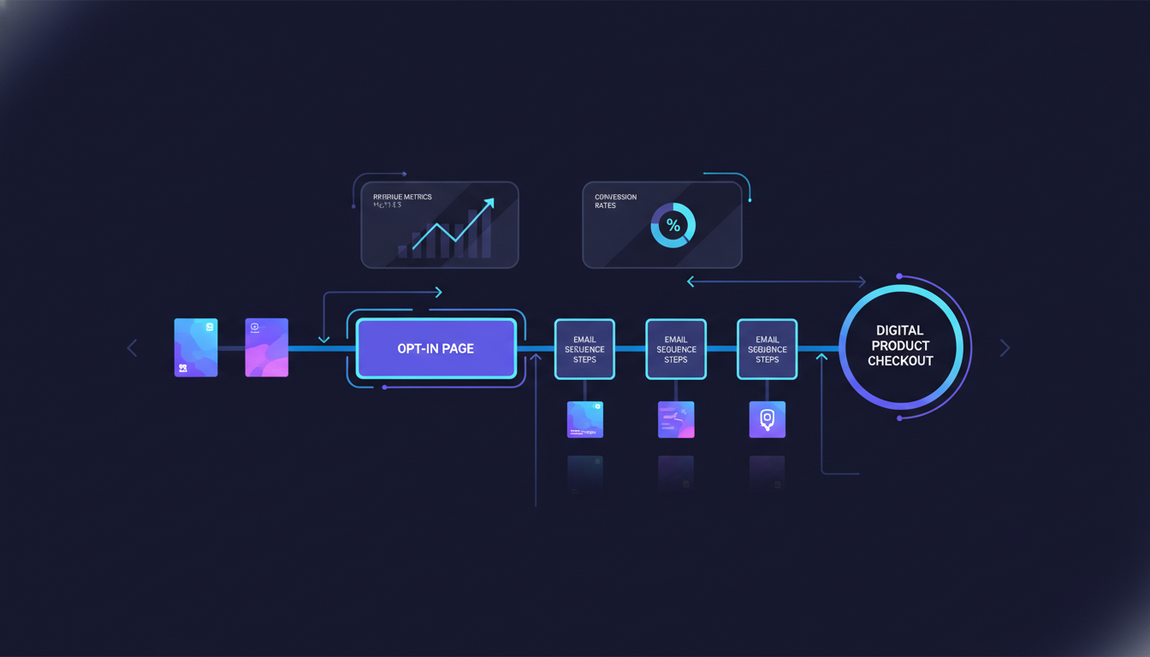
Strip it down and there are four moving parts. Think of them as building blocks: a solid offer or lead magnet, a landing page, an email nurture sequence, and perhaps automated demos.
Step 1 — The lead magnet. Your lead magnet is your funnel's front door. A good lead magnet solves a small, specific problem your ideal customer is already thinking about. It should be easy to say yes to, quick to consume, and naturally lead into your main offer.
Step 2 — The nurture sequence. After someone opts in for your lead magnet, they receive a series of pre-written emails that build trust, deliver value, and eventually pitch your offer. This is where most creators underinvest. If you want help structuring this part, the 5-email welcome sequence framework is a solid starting point.
Step 3 — The timed offer. This is the piece most evergreen funnels are missing. No matter when a person arrives in your sales funnel, they are presented with the exact same offer and have the exact same amount of time to take advantage of it. Once the deadline has passed and the countdown timer hits zero, they will no longer be able to access the discount. It's like each new subscriber entering your sales funnel has their own personalized flash sale.
Step 4 — The sales page. Every lead from the sequence lands here. A clear value proposition highlights how your offer solves a specific, year-round problem. Urgency and scarcity can be created with limited-time bonuses or exclusive features. Social proof uses testimonials and case studies to build trust and credibility. A clear sales page explains the offer, its benefits, and a strong call to action. If you want a repeatable template for this, see the 6-part sales page framework.
How I'd Approach the Traffic Side Today
A funnel with no traffic is just a set of empty pages. What feeds an evergreen funnel is evergreen content — the kind that compounds over time rather than dying in 48 hours.
Search-first platforms like Pinterest, blogs, and YouTube are game changers. Unlike social media posts that disappear in a day or two, these platforms can send you traffic for months or even years after you post.
Some funnels require constant traffic, which can be challenging to scale sustainably. The solution is to build evergreen content assets like YouTube videos that generate views long-term, reducing reliance on paid traffic.
What stands out is the simplicity of the loop: write a blog post or record a video that answers a real question in your niche → it drives search traffic for years → visitors opt into your lead magnet → the automated sequence converts them. By investing your efforts in growing and nurturing an engaged email list, setting up evergreen sales funnels, and pre-scheduling your content, you'll be able to make sales year-round without having to live launch your digital products.
What I Like / What I Don't Like
What I like — Once it's working, the feedback loop is clear. You can see exactly where people drop off — the opt-in rate, the email open rate, the sales page conversion — and fix one variable at a time without rebuilding from scratch every quarter.
What I like — You can double your traffic — and double your leads — without doubling your workload. That's genuine scale, not just more hustle.
What I don't like — The setup phase is front-loaded and easy to rush. Most people write a weak lead magnet, skip proper email sequencing, and wonder why the funnel doesn't convert. The system is only as good as the assets inside it.
What I don't like — Even with the best evergreen systems in place, you'll still need to drive traffic to those evergreen assets like your sales funnels or content. "Autopilot" doesn't mean zero ongoing input. It means the conversion work is automated — traffic still needs your attention, at least early on.
Bottom Line
An evergreen funnel is not a magic machine. It's a logical system: attract, nurture, convert, on a loop. Building an evergreen sales funnel provides you with a consistent flow of leads and sales without the need for constant intervention. By putting your sales process on autopilot, you can dedicate your time and energy to other important aspects of your business.
This setup makes sense if you have a digital product that solves a durable problem and you're tired of relying on launch windows to pay the bills. It also makes sense if you're building toward a business that doesn't require you to show up every week to generate revenue.
Skip it if your product needs live demos, heavy personalisation, or high-touch sales conversations to close. Evergreen works best for products priced under $300 where the buyer can self-qualify through content alone.
Build the lead magnet. Write the sequence. Set the deadline. Then feed it with content that compounds. That's the whole system.
Want more practical setups like this? See the AI tools that help automate the moving parts — or join the newsletter for more operator-level breakdowns of what's actually working in 2026. Subscribe here.