AI Personalization for Email Campaigns: What Actually Moves Open Rates in 2026 (And What's Just Noise)
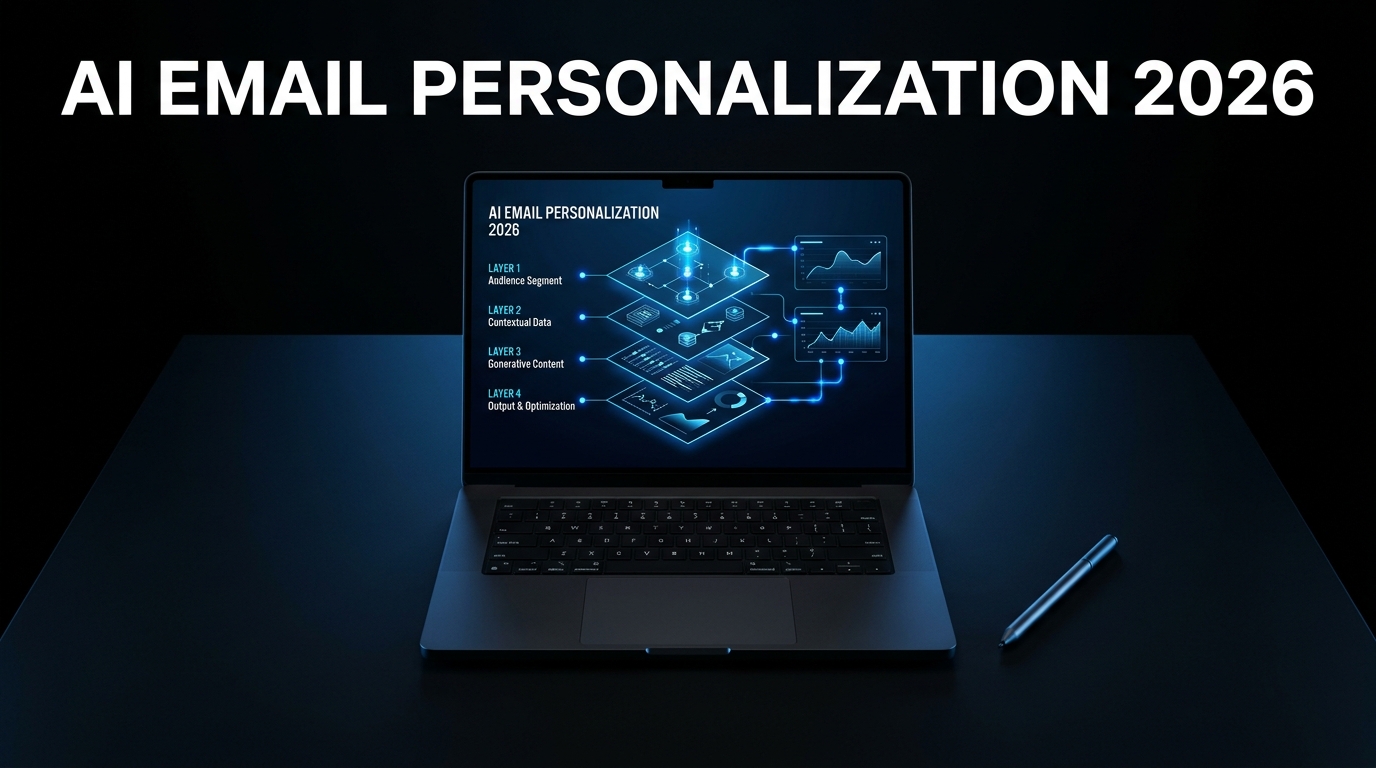
Every email platform in 2026 claims AI personalization boosts revenue by some impressive percentage, and the numbers being thrown around — 41% more revenue, 6x more transactions, 234% faster lead qualification — are real, but they describe the ceiling, not what a solopreneur running one email list actually gets from flipping on a feature toggle. The honest version is that AI personalization is not one thing. It is four distinct layers, each with a different implementation cost and a different actual impact on revenue. Confusing them is why so many solopreneurs enable "AI personalization" in their platform settings and see nothing change.
If you're short on time, here's the key takeaway: AI email personalization breaks into four layers, from easiest to most powerful: personalized subject lines and names, behavior-based segmentation, dynamic content blocks, and real-time behavior-triggered sends. Personalized subject lines alone lift opens by roughly 26%. Full AI-driven personalization — segmentation plus dynamic content plus send-time optimization working together — is associated with up to 41% more revenue than batch sends. For a solopreneur, the first two layers deliver most of the practical value with the least setup complexity. The upper layers matter more as your list grows past a few thousand subscribers.
Why Open Rate Alone Is the Wrong Way to Measure This
Before evaluating any personalization tactic, it is worth being honest about what open rate can and cannot tell you in 2026. Apple's Mail Privacy Protection auto-opens a portion of emails for roughly half of all subscribers, which inflates open rate data enough that it functions as a directional signal rather than a reliable metric. Revenue per recipient, click-through rate, and click-to-open rate are the numbers that actually correlate with business outcomes — and they are the metrics worth tracking when evaluating whether any personalization layer is genuinely working, rather than watching an open rate number that a meaningful share of your list did not generate through actual human attention.
This matters directly for a solopreneur trying to evaluate AI personalization claims. A vendor case study showing "41% more revenue" from AI personalization is more trustworthy than one showing "35% higher open rates," because the revenue figure is harder to inflate with privacy-protection artifacts. When you see personalization statistics, check whether they are measuring engagement (opens, which are noisy) or outcomes (revenue per recipient, clicks, conversions, which are cleaner).
Layer One: Subject Line and Name Personalization
This is the simplest layer and the one with the clearest, most consistently documented impact. Personalized subject lines are opened roughly 26% more often than generic ones, and AI-powered subject line testing — running five to ten variants simultaneously and measuring which performs best — produces open rate improvements of 35% to 95% compared to untested subject lines, with the larger gains showing up for senders whose baseline subject lines were generic to begin with.
The practical implementation for a solopreneur is straightforward: most modern platforms (Kit, ActiveCampaign, Beehiiv) include basic AI subject line suggestion or testing as a native feature, requiring no additional tool or technical setup. This is the highest-return, lowest-effort layer available, and it is worth implementing before any of the more complex layers described below — assuming your emails are actually reaching the inbox in the first place, which is a separate problem covered in email deliverability for solopreneurs.
Layer Two: Behavior-Based Segmentation
Segmentation is the layer that separates a mailing list from an actual email marketing system. Hyper-segmented campaigns targeting micro-audiences of 500 to 2,000 contacts outperform broad, undifferentiated segments by roughly 3.4x on conversion rate. The most effective segmentation in 2026 combines behavioral data — purchase history, content engagement, browsing patterns where available — with AI-predicted intent scores, rather than relying on demographic fields like name or location alone.
For a solopreneur, the practical starting point is segmenting by lifecycle stage and engagement level rather than attempting sophisticated predictive scoring immediately. A subscriber who joined this week, opened your last three emails, and clicked a specific link is meaningfully different from one who joined six months ago and has not opened anything in ninety days — and sending both the identical broadcast wastes the opportunity that segmentation exists to capture. This connects directly to the broader email marketing systems framework — segmentation is the infrastructure that makes every other personalization layer possible.
Layer Three: Dynamic Content Blocks
Dynamic content adapts sections of an email based on subscriber data or behavior — showing a different product recommendation, a different case study, or a different call to action depending on what the platform knows about that specific recipient, all within a single email template rather than building separate campaigns for each segment.
This layer requires more setup than subject line personalization or basic segmentation, but it compounds with the segmentation work already done. If your subscribers are already segmented by interest or lifecycle stage, dynamic content blocks let a single send serve each segment its most relevant version without maintaining four separate campaigns manually. For a solopreneur without a large team, this is where AI genuinely earns its keep — the platform assembles the personalized version automatically rather than requiring you to build and send multiple campaigns by hand.
Layer Four: Real-Time Behavior-Triggered Sends and Send-Time Optimization
This is the most sophisticated layer and the one where the return on complexity starts to diminish for a smaller list. Real-time, behavior-triggered personalization adapts as the subscriber acts — a cart abandonment, a specific page visit, a completed purchase — and AI send-time optimization analyzes each individual subscriber's engagement patterns to deliver at their personal optimal moment, rather than batch-sending everyone at a fixed time.
Send-time optimization alone delivers a 15% to 23% open rate improvement compared to fixed-time batch sending, because messages arrive when each subscriber is actually likely to check email rather than competing with everything else that landed in their inbox at 9am sharp. This layer is worth implementing once your platform supports it natively — most modern platforms now do — but it is not worth switching platforms or adding a new tool solely to access it if the first three layers have not already been implemented.
What the Revenue Numbers Actually Mean for a Small List
The headline statistics — AI-optimized campaigns averaging a 13.44% click-through rate compared to 3% for non-AI campaigns, or a 40% faster revenue growth rate for AI-personalized campaigns — describe aggregate outcomes across large datasets, not a guarantee for any individual sender. What they reliably indicate is direction, not magnitude: personalization consistently outperforms batch-and-blast, and the gap widens as more layers are implemented together rather than in isolation.
For a solopreneur with a list under a few thousand subscribers, the practical priority order is subject line personalization first (highest return, lowest effort), behavior-based segmentation second (foundational for everything else), dynamic content third (compounds with segmentation), and real-time triggers plus send-time optimization last (highest complexity, meaningful but incremental return once the first three layers are working). Implementing all four simultaneously on a small list is less important than implementing the first two well and expanding from there as your list and revenue justify the additional complexity.
What I Like / What I Don't Like
What I like: The four-layer framework genuinely clarifies what "AI personalization" actually means, which is useful given how loosely the term gets applied in platform marketing. Subject line and segmentation improvements are accessible to a solopreneur with no technical setup beyond what modern email platforms already provide natively. The shift toward revenue-per-recipient as the primary success metric, rather than an open rate inflated by privacy protections, is a genuine improvement in how to actually evaluate whether any of this is working.
What I don't like: The headline statistics circulating in 2026 marketing content are frequently cited without clear methodology, and comparing a 41% revenue lift claim across different studies without matching baseline and audience size is not a reliable way to set expectations for your own list. The upper layers — real-time triggers, sophisticated predictive segmentation — genuinely do require more subscriber volume before the complexity is worth the setup time, and platforms rarely make this trade-off explicit before you invest in building it. And "AI personalization" as a feature toggle in many platforms is doing considerably less than the four-layer framework implies — verify what a specific platform's AI feature actually does before assuming it covers the deeper layers.
Bottom Line
AI email personalization is not a single switch to flip. It is four layers of increasing complexity and increasing return, and the right starting point for a solopreneur is the first two — subject line personalization and behavior-based segmentation — which deliver most of the practical revenue impact with the least implementation overhead. Dynamic content and real-time triggers matter more as your list grows, and they are worth building once the foundational layers are already working rather than attempting all four simultaneously from a standing start.
Who should implement this now: any solopreneur currently sending identical broadcasts to their entire list regardless of subscriber behavior or engagement history. Who can wait on the upper layers: anyone with a list under a few hundred subscribers, where segmentation and subject line personalization alone will capture most of the available improvement before the more complex layers justify their setup cost.
Join the newsletter for more practical AI workflows and email marketing systems.